
As an Amazon Influencer, we earn from qualifying purchases you might make if you click any of the links or buttons on this page.
Ham Radio For Beginners – Ham Radio Guide
Ham radio experience is a remarkable one.
And if you have been in this for a while, I know you know the feeling.
But what if you’re just looking into this as a new hobby?
The truth is: you’re about to be part of a big community of Ham geek hobby enthusiasts and the experience will blow your mind!
There were about 765,000 Ham operators in the USA as of 2019 and around 3 million worldwide
It’s not just about holding a nice gadget and using it to communicate with folks all over. Its beauty lies in the transformation.
You’re properly wondering, “Why Ham radio?”
Ham radios are reliable and affordable. It’s possible to miss out on news or emergency update with the normal communication systems.
However, Ham radio will always set you ahead of the pack since its transmission and reception are never affected by bad weather. This means you will always stay updated when bad weather damages communication infrastructure.
Check This: Best Weather Radios
Besides, you’ll be getting constant updates from Ham users nearby. But what’s more amazing is that you can learn and master the skill.
There’s more to learn about Ham radio. That’s why I have compiled this jam-packed guide for beginners with tons of value for you.
So, let’s get started!
What is Ham Radio?
Ham Radios are also known as Amateur Radios.
But what are they?
Well, this is the use of a specialized set of radio frequencies to pass information from one user to another. The users are spread all over the world and they use Ham radio for non-commercial purposes.
More often than not, these include; emergency communication, radio sport, contests, self-training, or private recreation. This is what makes it a popular hobby. It brings people together, thereby creating a community of Ham users all over the world.
As a member of the community, you interact with other users in your neighborhood, town, country, the whole world, and even outside space. Isn’t that fun?
What makes them more reliable is that you can set and use them anywhere. You can have one in the open field, a club station or at home. The location doesn’t really matter!
But this is not all to Ham radios. There are a ton more benefits than you can imagine.
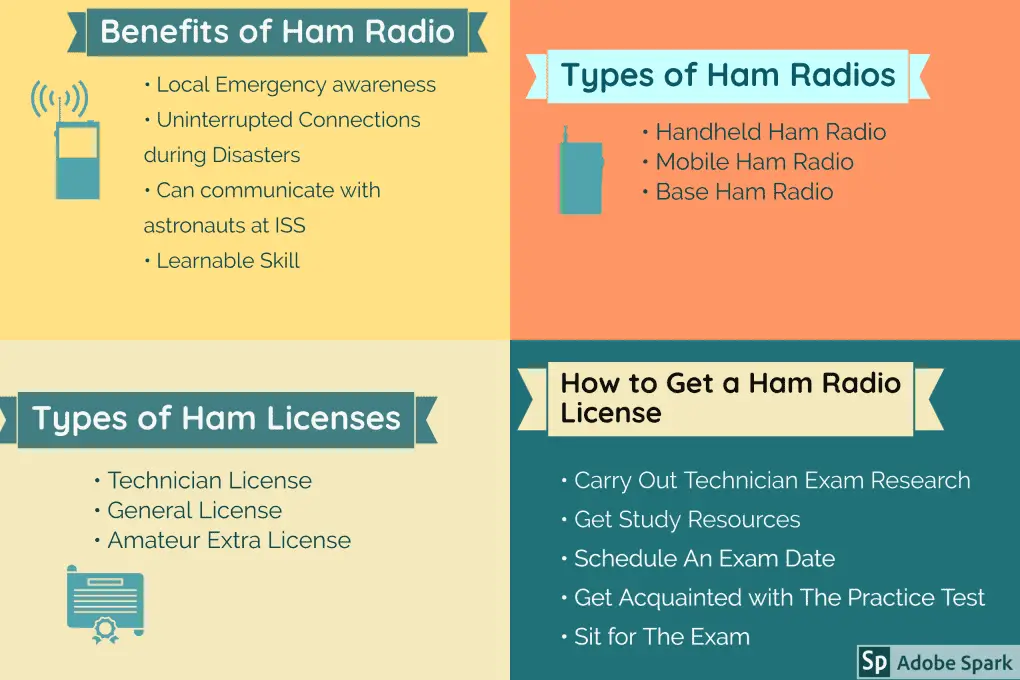
Benefits of Ham Radio
a) Local Emergency awareness: You are likely to experience disappointments and delays with the local TV news channels.
What’s even worse is the wrong information that is peddled on social media. What would you do in such circumstances?
Ham radios are reliable and you will always get the news on time when there’s an emergency.
Better still, the information comes from the source and you can rely on its credibility.
While everyone will be waiting for a secondary reporting from the media, you will stay ahead of them. With this radio, you get the info while it’s hot.
b) Uninterrupted Connections during Disasters: Bad weather and other acts of God have a way of interfering with the normal communication channels.
At such times, radio broadcasts become super useful. Ham radio enables you to stay connected with your community even when there are power outages
c) Learnable Skill: It’s easy to operate a Ham radio. All you need are the right set of skills. The good news is that you can acquire the skills stress-free.
Once you’re well equipped, you’re good to launch into the coveted experience. You can either enroll for classes or go on a self -studying mode.
It’s that simple!
Wait a sec, don’t you think it’s worth knowing how all these started? Right…that’s what I’m about to show you.
| General Ham Radio Links |
|---|
| FCC Amateur Radio Service Official Website ARRL – American Radio Relay League International Amateur Radio Union Winlink 2000 (WL2K) Global Radio Email System |
History of Ham Radio
In the 1890s Guglielmo Marconi – an Italian inventor- championed the use of radio waves into the communication systems which later led to the birth of the amateur radio.
First, amateur radio users connected over wired telegraph systems. Shortly after that, the wireless system was adopted by Ham users.
In 1904, some 8th graders made a transmitter together with a receiver. This worked well within an 8 miles range.
In 1906, two teenagers from Rhode Island built a wireless station in a chicken coop.
In 1908, the first wireless telegraph club was established. Today this is known as the New Colombia University Amateur Radio Club.
Fast forward, after the two world wars, new amateur radio bands were established in 1972. These included 30m, 17m, and 12m.
In the present times, Ham users identify these as WARC bands. But much later on, the Morse code proficiency test was eliminated.
This test had put a limitation on the number of Ham users globally. Today, you can easily be a part of this international community. Thanks to the international communications union.
A good story never ends. That’s why the story of Ham radio keeps going. Over the course of time, there have been other types of radio. I have a couple that you should know about.
Types of Radios
a). Amateur “Ham” Radio

Amateur radio is also known as Ham radio. This type of radio uses radio frequencies to pass information from one user to another.
It’s worth noting that ham radios used for non-commercial purposes. Some of these include emergency communication, radio sport, contests, self-training, and private recreation.
b). Citizen’s Band (CB)
The CB radio is a two-way land mobile radio that allows bi-directional voice communication between two persons.
The radio operates in 40 channels and works well under short distances and a high frequency of 27 MHz.

It’s also worth noting that the radio can be stationary, portable, or mobile. Compared to Ham radio, Citizen’s Band radio doesn’t require licensing.
Besides, you can use it for commercial purposes as well as personal communications.
c). Family Radio Service (FRS)
FRS is a better version of Walkie talkie radio that is immune to interferences effects associated with citizen’s Band radio.
FRS uses 462 MHz and 467 MHz channelized frequencies in the ultra-high frequency band.

Besides, the radio operates on frequency modulation (FM), unlike other radios that operate on amplitude modulation (AM).
FRS is versatile and can be used both for commercial and non-commercial purposes.
Often, it’s used as a low-cost option by businesses since it doesn’t require licensing.
d). General Mobile Radio Service (GMRS)
GMRS is a handheld and portable radio device that shares a frequency with FRS radios. This means they operate around 462 and 467 MHz UHF band.
While the use of this radio requires licensing in some countries, for others it’s license-free. For example, in the US, you require licensing to own the radio.
The best part is that the immediate family members are covered by a single license. Therefore, family members can communicate amongst themselves stress-free for personal or business reasons.
On the flip side, employees of the business are not covered by the license. Therefore, it’s illegal for them to use the radio.

Moreover, this radio is designed to operate on frequency modulation (FM) and ultra-high frequency (UHF) over short distances.
e). Multi-Use Radio Service (MURS)
MURS, like Citizen’s Band, are a licensed bidirectional radio that allows communication exchange between two persons.

Also, this communication takes place in the very high-frequency bands while the radio is running at a maximum power consumption of 2 watts.
The radio is licensed for both personal and commercial purposes. And the good part is that its use is open to the general public.
Check This: Best MURS Radios
f). DMR Radio
Digital mobile radio (DMR) can use either ultra-high-frequency or very high-frequency bands.
The radio operates on time-division multiple access (TDMA) technology that allows users to access the frequency channel at specific times.
By this, each signal is divided into specific time slots and at 12.5 kHz.

That’s all for types of radios. In this guide, the focus is on Ham radio, and in the next section, you’ll discover all the types of Ham radio.
Types of Ham Radio
Ham radio is designed for different sets of operations. For each type of Ham radio, there are features that enable a particular type of use.
Also, a key influencer in this is the expected range of contact between the main participants in the communication channel.
Here are some of the types of Ham radio based on the above features.
- Handheld Ham Radio – This type has transmitter outputs for FM voice, and operates on VHF and UHF bands. More importantly, you can only use it when it’s held in your hands hence the name “handheld”. Also, for power sources, the radio runs on rechargeable batteries.

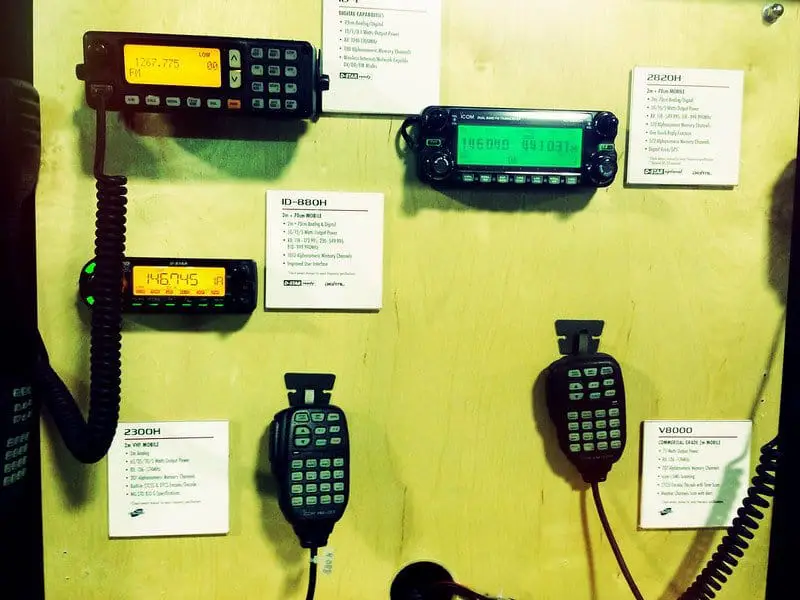
- Mobile Ham Radio – This type is made exclusively for operation in vehicles. It runs on FM voice, VHF and UHF bands. Besides, with this radio, you will need a direct current power supply for it to work well.

- Base Ham Radio – This kind is designed for fixed and stationary use. It’s super powerful and operates on a high volume supply of power.

Ham Radio Licenses
Being a Ham radio user requires licensing so that you don’t find yourself on the wrong side of the law.
1. Types of Ham Licenses
Before 1999, there were up to 6 Ham licenses that FCC expected Ham users to have.
In 2000 after lengthy consultative meetings, FCC reduced the number to the current three. These include; Technician, General, and Amateur Extra.
License acquisition is progressive and you have to pass the test on one level so that you progress to the next.
a) Technician License
This license is used by beginners or entry-level Hams. To get this license, you must take an exam of 35 questions on radio theory.
The test will also check how well you know the radio regulations in your jurisdiction and how to operate a Ham radio.
This license limits the frequencies in which you can transmit or receive signals. Therefore, you’re confined to below 30 MHz.
This will only enable you to have local communications since the range only permits this.
For international connections, the license allows limited access and privileges to HF bands.
b) General License
To attain this license, you must pass the Technician level in addition to a 35 questions test exam.
The benefits of this license include all the features in the Technical level and additional privileges of access to most of the HF bands.
The test objectives at this level are the same as the Technician’s level. The only difference is that they cover more details under General license.
c) Amateur Extra License
This is the topmost level of Ham licensing. At this level, you will have access privileges to multiple High-Frequency bands.
To get the license, you must pass a test exam of 50 questions of which you must answer 37 correctly to qualify.
The test is quite complex compared to the previous levels and entails more rules and regulations and high-level technical topics.
2. How to Get a Ham Radio License
As an amateur radio enthusiast, you’ll need to register for radio classes– Technician and General– before you can get your license.
Here are the exact steps you need to take so that you secure your license.
Step 1: Carry Out Technician Exam Research
This exam is relatively easy and you get your license without much struggle.
There are four main topics that are covered at this level. Therefore, you need to acquaint yourself with t