
Best DMR Radios for Ham Radio (2026)
For most DMR operators, get the AnyTone AT-D878UVII Plus for its mature ecosystem. Spend less on the GD-168, or choose the DA-7X2 when true dual receive matters.
Quick Picks
The best DMR radio depends less on raw wattage than on programming support, receiver behavior and the features you will actually use. These three cover the strongest mainstream buying paths.
AnyTone AT-D878UVII Plus
The safest all-round choice when you want a huge installed user base, mature CPS/codeplug support, GPS, Bluetooth and APRS.
- + 4,000 channels, 10,000 talkgroups and 500,000-contact database
- + GPS, Bluetooth, roaming and analog/digital APRS
- − Mature does not mean simple—DMR still requires a real codeplug workflow
Radioddity GD-168
A strong budget route when you want modern DMR capacity, USB-C programming/charging and two batteries without paying for GPS or Bluetooth.
- + 4,000 channels, 10,000 talkgroups and 500,000 contacts
- + USB-C plus two batteries and two antennas in the current package
- − The software/community ecosystem is smaller than AnyTone’s
BTECH DA-7X2
The better choice when you want genuinely simultaneous VHF/UHF monitoring plus a newer BTECH-developed firmware platform.
- + True simultaneous dual receive
- + GPS, Bluetooth, APRS, roaming, recording and cross-band tools
- − More complex than necessary for somebody who only wants one DMR repeater
Compare the Best DMR Radios
| Radio | Best For | Channels / Contacts | GPS / APRS | Standout Feature | Support | Action |
|---|---|---|---|---|---|---|
| AnyTone AT-D878UVII Plus | Mature DMR ecosystem | 4,000 / 500k | GPS + analog/digital APRS | Bluetooth, roaming, huge community | Current CPS/firmware + large codeplug ecosystem | Current price → |
| Radioddity GD-168 | Lower-cost modern entry | 4,000 / 500k | No GPS | USB-C + dual batteries | Radioddity CPS | Current price → |
| BTECH DA-7X2 | True dual receive | 4,000 / 500k | GPS + APRS | Simultaneous dual receive | Active BTECH firmware/CPS | Current price → |
| AnyTone AT-D168UV | Simple AnyTone entry | 4,000 / 500k | No GPS / APRS | Two batteries + USB-C | Current AnyTone CPS/firmware | Manufacturer → |
| BTECH DMR-6X2 PRO | Mature BTECH platform | 4,000 / 500k | GPS + analog/digital APRS | Recording, roaming, Talker Alias | Firmware 1.21 / CPS 1.22E | Current price → |
| Ailunce HD2 | Rugged outdoor DMR | 3,000 / 500k | GPS | IP67 + 3200 mAh | Current CPS/firmware | Manufacturer → |
| AnyTone AT-D890UV | Newest AnyTone flagship | 4,000 / 500k | GPS + APRS capable | SFR, cross-band repeat, airband AM | Current 2026 CPS/firmware | Manufacturer → |
Swipe to compare →
Which DMR Radio Fits You?
1. AnyTone AT-D878UVII Plus — Best Mature DMR Ecosystem

The AT-D878UVII Plus remains my default DMR recommendation even though newer radios now exist.
The reason is not that its specification sheet is unbeatable. It is that DMR ownership includes the radio, CPS, firmware, codeplug examples, troubleshooting information and the number of other operators who already know the platform.
AnyTone’s current U.S. listing still gives the UVII Plus 4,000 channels, 500,000 digital contacts, Bluetooth, GPS and APRS capability. The manufacturer also supports roaming and front-panel VFO programming.
That feature mix is deep enough for advanced use without making the radio dependent on experimental software. And because the 878 family has been popular for years, examples of zone layouts, button assignments and codeplug workflows are much easier to find than for a brand-new platform.
Wholly Outdoor also has a dedicated AnyTone AT-D878UVII Plus review, so this is one recommendation where our coverage extends beyond merely reading the specification sheet.
The limitation is that mature does not mean effortless. A new DMR operator still has to understand Radio IDs, color codes, time slots, talkgroups and zones. If that sounds like unnecessary complexity and your local repeaters are mainly analog, start with our regular handheld-radio guide instead.
Best for: operators who want the mature, widely documented all-round DMR path.
Skip it if: you only need a few DMR channels and do not care about GPS, APRS or Bluetooth.
Watch Our AnyTone AT-D878UVII Plus Review
Our dedicated review gives you a closer look at the radio itself. Use this buyer guide for the current market comparison and DMR setup workflow.
2. Radioddity GD-168 — Best Lower-Cost Modern Entry
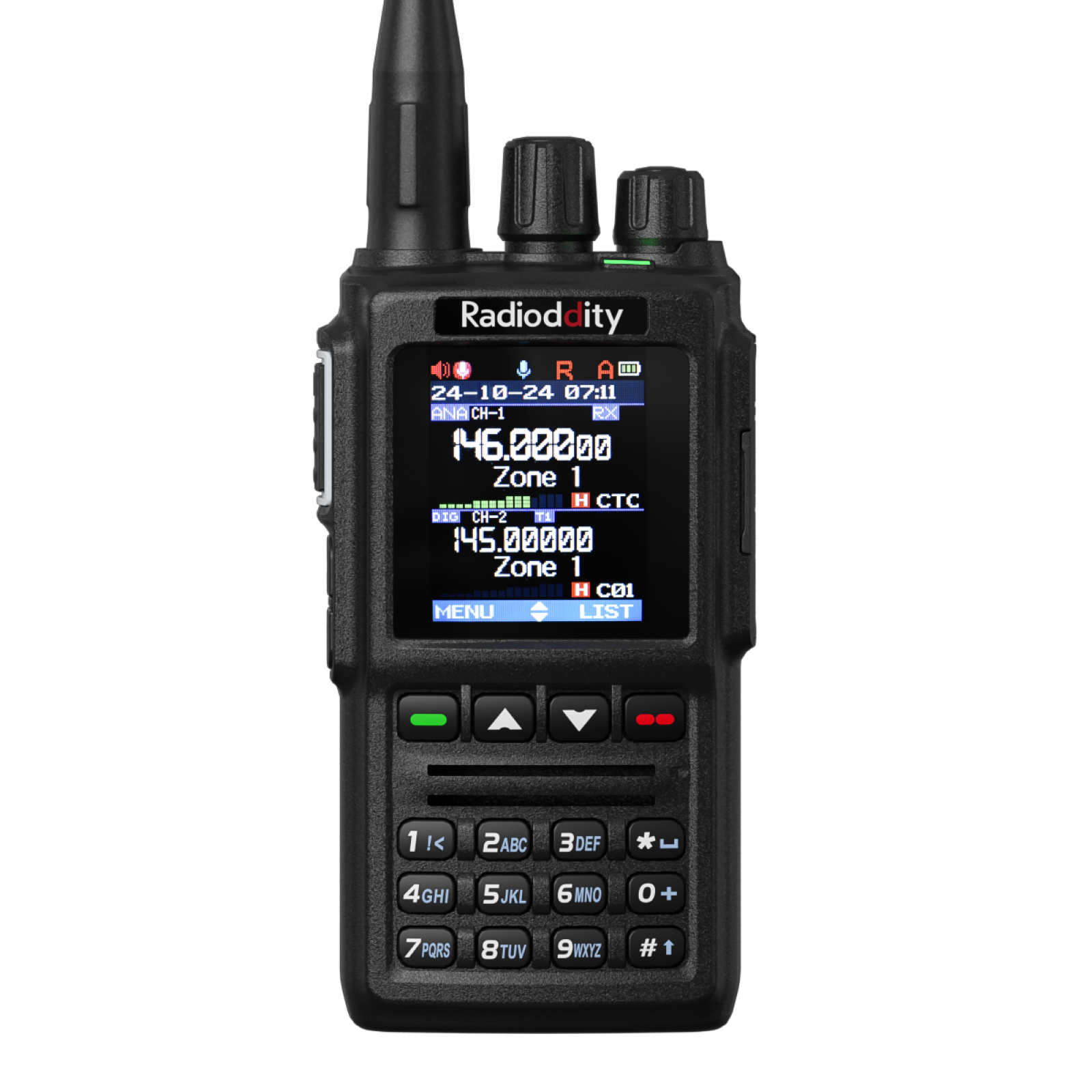
The GD-168 remains the budget recommendation because Radioddity modernized the parts that matter to an entry-level DMR owner rather than simply keeping an old GD-77-era platform alive.
It supports 4,000 channels, 10,000 talkgroups and a 500,000-contact database. The current package also includes USB-C charging and programming, two batteries and two antennas.
Those capacity figures matter because DMR creates more configuration objects than analog FM. A radio with very limited channels or contact storage becomes frustrating quickly once you start building several zones or importing a larger caller database.
I would not choose the GD-168 because of its advertised wattage. Radioddity’s own product material has not always been perfectly consistent about the maximum output figure, and the practical difference between neighboring handheld power claims is much less important than repeater coverage and antenna placement.
If range is the problem, check our handheld antenna guide before replacing the radio.
Best for: a beginner who wants modern DMR capacity and USB-C without paying for advanced GPS/Bluetooth features.
Skip it if: community codeplug availability and long-established platform support matter more than the purchase price.
3. BTECH DA-7X2 — Best When True Dual Receive Matters
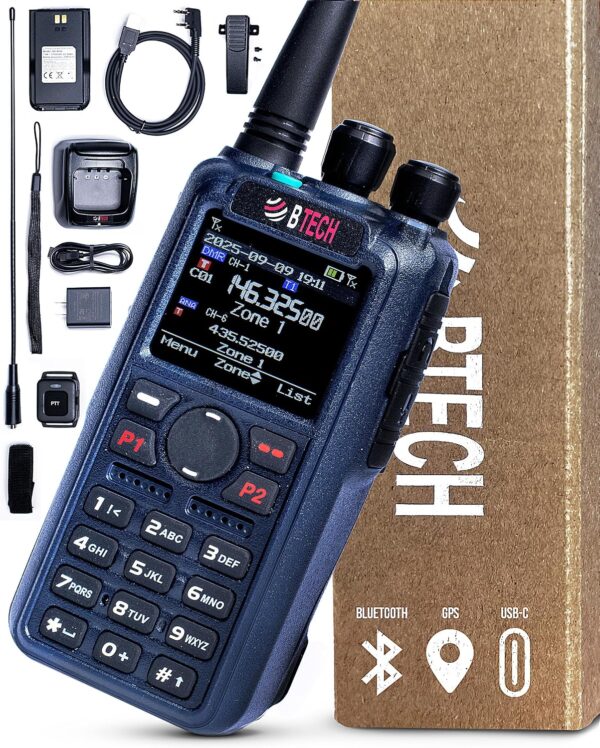
The DA-7X2 is the recommendation that has changed the most since this page was first published.
Its defining hardware feature remains true simultaneous VHF/UHF dual receive. That is genuinely different from a radio that merely displays two frequencies and rapidly alternates one receiver between them.
BTECH currently gives it 4,000 channels, 250 zones, 10,000 talkgroups and a 500,000-contact database, plus GPS, Bluetooth, analog and digital APRS functions, roaming, recording, airband AM receive, satellite tools and cross-band repeater functions.
The bigger 2026 development is software support. On August 22, BTECH released DA-7X2 firmware 1.05d2 and CPS 1.05d. The update adds functions including simplex call recording/replay, improved scan grouping and priorities, and persistent temporary talkgroup handling.
BTECH describes this as its first internally developed DA-7X2 firmware fork, which matters more to me than another line in the launch specification sheet: it shows that the platform is being actively developed after sale.
The current download package contains separate Standard and NXDN branches. If you are buying the radio for ordinary amateur DMR/analog operation, follow BTECH’s model-specific instructions and do not mix files between firmware branches.
Best for: advanced DMR users who actually benefit from monitoring two signals simultaneously and want an actively developed BTECH platform.
Skip it if: your DMR usage is one repeater, one timeslot and a handful of talkgroups.
4. AnyTone AT-D168UV — Best Simple Entry Into the AnyTone Ecosystem
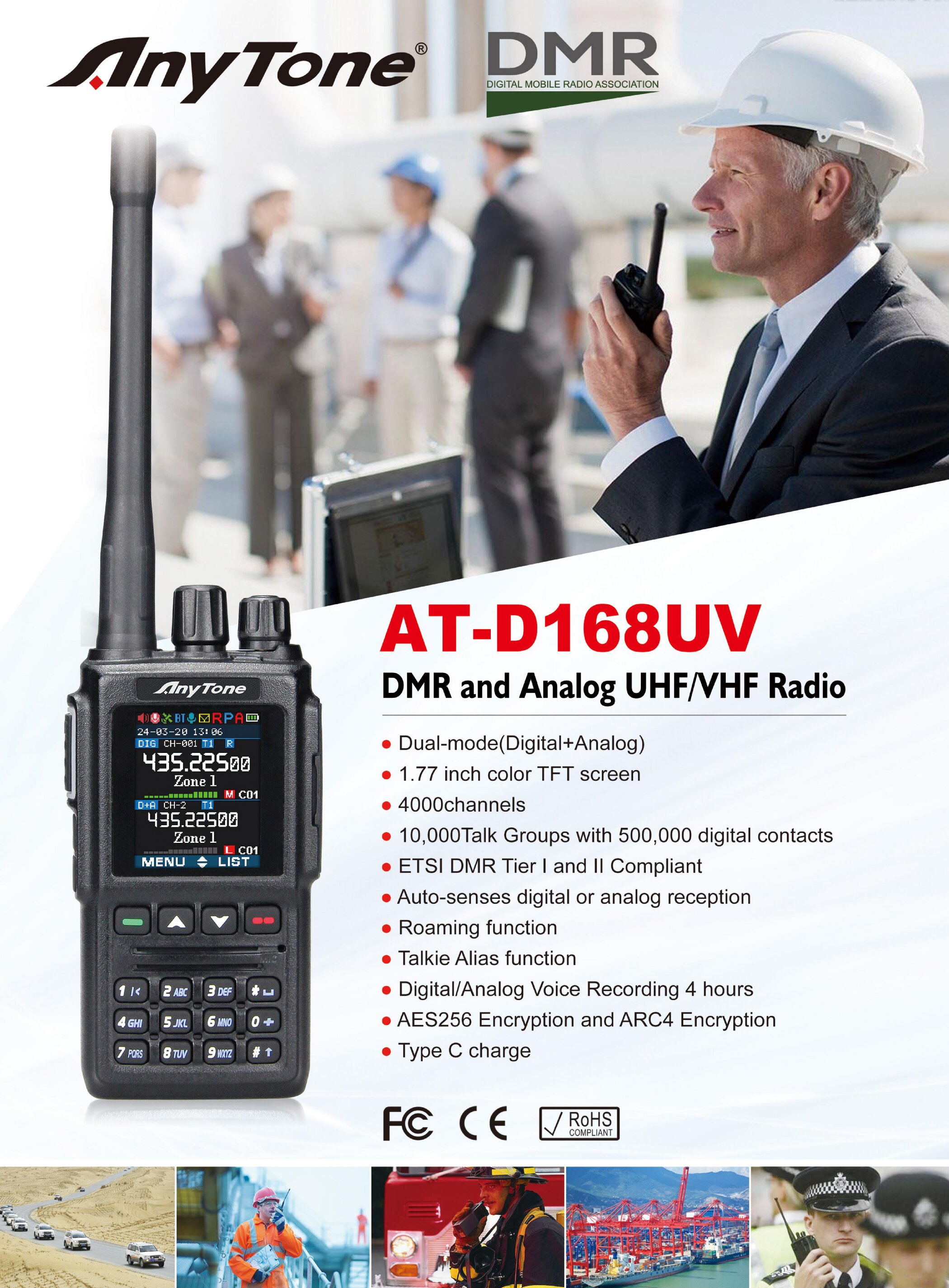
The D168UV is a more important addition than it first appears because it gives beginners access to the current AnyTone ecosystem without paying for an 878 feature list they may never use.
AnyTone explicitly describes the D168UV as its entry-level dual-band DMR/analog handheld. The current U.S. model supports 4,000 channels, 10,000 talkgroups and 500,000 digital contacts.
What it deliberately leaves out is equally important: no GPS and no Bluetooth.
In exchange, the current package includes both an 1800 mAh and 2500 mAh battery, two antennas, and USB-C charging/programming.
For somebody whose actual goal is “I want to use my local DMR repeater and learn AnyTone CPS,” that can be a better fit than buying the 878 and leaving Bluetooth, GPS and APRS untouched.
AnyTone’s current U.S. download page also still supplies model-specific D168UV firmware and CPS, which is exactly the kind of support I want to see before recommending a lower-priced DMR radio.
Best for: beginners who want an AnyTone DMR workflow without paying for GPS, APRS and Bluetooth.
Skip it if: those advanced connected features are exactly why you are shopping for DMR hardware.
5. BTECH DMR-6X2 PRO — Best Mature BTECH Platform
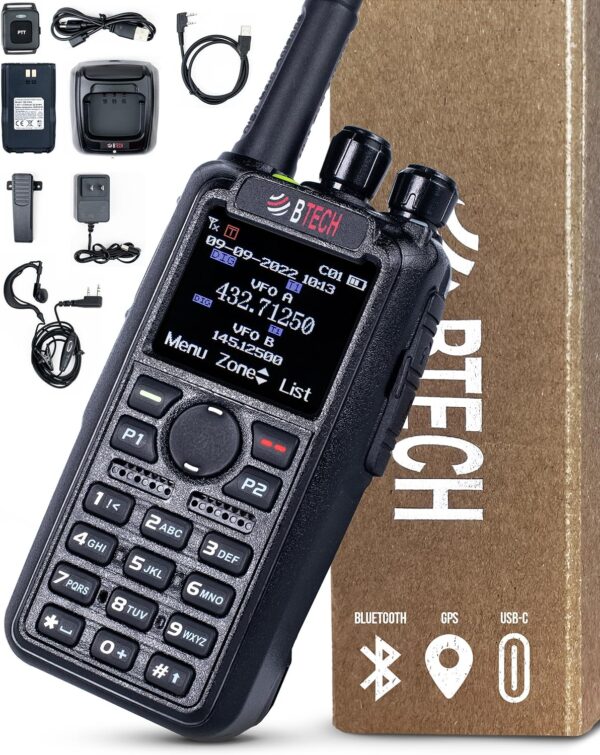
The DMR-6X2 PRO should no longer be buried in a short “also consider” paragraph. It still has a clear reason to exist next to the newer DA-7X2.
BTECH currently specifies 4,000 channels, 250 zones, 10,000 talkgroups and a 500,000-contact database. You also get GPS, analog and digital APRS transmit/receive, Bluetooth, roaming, Talker Alias, voice recording and Store & Forward functionality.
The advantage over jumping immediately to the DA-7X2 is maturity. BTECH’s current repository provides firmware 1.21 with revised CPS 1.22E and keeps older versions documented for recovery.
BTECH also supports converting/importing compatible AnyTone 868/878-style codeplug data into the DMR-6X2 PRO workflow. That can matter if you already have an established codeplug rather than starting from zero.
One programming warning is important: BTECH’s DMR radios use model-specific Windows CPS and firmware. CHIRP does not program the DMR-6X2 PRO or DA-7X2. Do not choose a firmware file because the radios look similar.
Our programming guide explains why the first step should always be reading the radio and saving a clean backup.
Best for: somebody who wants an established BTECH DMR platform and mature firmware rather than the newest hardware.
Skip it if: the DA-7X2’s true simultaneous dual receive is a feature you will use regularly.
6. Ailunce HD2 — Best Rugged Outdoor DMR Radio
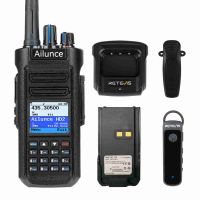
The HD2 earns a place because not every DMR buyer is sitting at a desk loading codeplugs.
Ailunce’s current product specification gives the HD2 IP67 construction, a 3200 mAh battery, GPS, Bluetooth, USB-C charging and a 500,000-contact database. It stores 3,000 channels and supports front-panel/VFO operation.
That combination makes far more sense for event work, camping and other outdoor use than choosing a radio solely because it has the largest possible memory number.
Ailunce is also still maintaining the platform. Its current support page lists HD2 V3 firmware 3.1.7 dated July 17, 2026, along with current CPS and Windows 11 USB-driver support.
If you are building a DMR radio into a wider field kit, continue to our portable ham-radio guide for battery, antenna and go-kit planning.
Best for: outdoor operators who put waterproofing, battery capacity and physical durability ahead of maximum channel capacity.
Skip it if: the AnyTone/BTECH community and codeplug ecosystem matters more than ruggedness.
7. AnyTone AT-D890UV — Best New AnyTone Flagship

The AT-D890UV is the newest AnyTone that seriously challenges the 878, but I would not automatically replace the mature 878 with it at the top of this guide.
AnyTone’s current 2026 platform keeps the familiar 4,000-channel and 500,000-contact scale while adding newer hardware features including airband AM receive, Single Frequency Repeater operation, cross-band repeating and USB-C.
AnyTone USA also lists Bluetooth, GPS, satellite functions and APRS capability on the current model.
The radio’s SFR feature is particularly unusual. Single Frequency Repeater operation uses the DMR time-slot architecture to support repeater-like functionality on one RF channel. That is an advanced feature—not something a beginner should use as the reason to buy their first DMR radio.
The other advantage is current software support. AnyTone USA lists AT-D890UV firmware/CPS version 1.05 dated May 21, 2026.
The reason the 878 still wins the main recommendation is maturity. The D890UV needs time for the community’s codeplugs, tutorials and accumulated troubleshooting knowledge to catch up with the older platform.
Best for: experienced AnyTone users who specifically want the newest platform, SFR, cross-band functions and airband receive.
Skip it if: you value the mature 878 ecosystem more than new hardware features.
Before You Buy Any DMR Radio: Check What You Can Actually Use
Do this before comparing GPS, Bluetooth or screen size.
Search RepeaterBook’s DMR listings and check your local radio club.
For the repeaters you could realistically reach, write down:
- frequency;
- offset;
- color code;
- network;
- which time slots the owner uses;
- which talkgroups are static or commonly activated.
Do not assume that every DMR repeater is connected to BrandMeister. DMR is the radio standard; BrandMeister is one network that can connect DMR repeaters and hotspots.
Your First DMR Setup, in the Right Order
Start with one known repeater or one hotspot—not an entire state’s codeplug.
For networked amateur DMR operation, register through RadioID.net and associate the ID with your callsign.
Do not install firmware or programming software merely because another model looks similar.
This gives you a recovery point before importing contacts or changing hundreds of channels.
Enter the repeater frequency/offset, color code, time slot and one known talkgroup.
Only after one channel works should you expand into zones, roaming lists and larger codeplugs.
BrandMeister’s current registration documentation also requires a Radio ID before creating a BrandMeister account. That is another reason to get the ID sorted before treating the hotspot or network as the first configuration problem.
What Is a DMR Codeplug?
A codeplug is the radio’s programming database.
It is more than a list of frequencies. Depending on the radio, it can contain:
- channels;
- zones;
- digital contacts and talkgroups;
- receive groups;
- scan lists;
- roaming lists;
- button assignments;
- APRS settings;
- Radio ID information;
- repeater-specific color codes and time slots.
+ TALK GROUP / DIGITAL CONTACT
+ FREQUENCY & OFFSET
+ COLOR CODE
+ TIME SLOT
= DMR CHANNEL
CHANNELS → ORGANIZED INTO ZONES
This is why blindly uploading somebody else’s giant codeplug is such a poor first step.
The DMR Terms You Actually Need to Understand
Why DMR Has Two Time Slots
DMR Tier II uses two-slot TDMA—Time Division Multiple Access.
The DMR Association’s current standards overview explains that a single 12.5 kHz DMR channel is divided into two alternating time slots.
That allows the channel to support two independent communication paths.
↓
TIME SLOT 1 → COMMUNICATION PATH A
TIME SLOT 2 → COMMUNICATION PATH B
You still need to program the time slot the repeater operator/network expects for the talkgroup you intend to use.
Static vs Dynamic Talkgroups
These terms describe how network traffic is delivered, not two different kinds of radio.
BrandMeister’s current documentation defines a static talkgroup as one configured to remain active on a repeater or hotspot, so matching traffic is sent to it whenever that talkgroup is active.
A dynamic talkgroup is activated temporarily by a local user’s PTT activity. How long it remains active can depend on the master server and configuration.
See BrandMeister’s current static-vs-dynamic documentation rather than relying on somebody’s years-old cheat sheet.
Do You Need a DMR Hotspot?
Not automatically.
If you already have a usable DMR repeater covering your operating location, learn that first.
A hotspot becomes useful when:
- there is no usable DMR repeater nearby;
- you want network access from home;
- you travel somewhere without compatible repeater coverage;
- you want more control over the network/talkgroups available to your own station.
↓ RF
HOTSPOT
↓ INTERNET
DMR NETWORK
↓
TALKGROUP / DESTINATION
A hotspot adds a configuration layer; it does not remove one.
BrandMeister’s current hotspot setup documentation requires the radio and hotspot to agree on items such as frequency, color code and the talkgroups programmed into the radio.
BrandMeister also requires Hotspot Security for hotspot connections. Configure the password through the BrandMeister dashboard rather than reusing your ordinary account password.
Do Not Start With a Giant Downloaded Codeplug
A giant regional codeplug looks convenient because somebody has already entered hundreds of repeaters.
The problem is that you do not know:
- when it was last updated;
- whether the repeater owner changed network or time-slot conventions;
- whether it was built for your radio/firmware generation;
- which zones or scan lists the original author intended;
- whether importing it will overwrite your own working configuration.
Start with one repeater. Make one contact. Then expand.
That same backup-first principle applies to firmware updates. BTECH’s current DMR repositories explicitly tell owners to read and save the radio’s current codeplug before installing model-specific updates.
DMR Contact Database vs Codeplug Contacts
These are easy to confuse.
A radio may advertise storage for hundreds of thousands of DMR contacts because it can hold a large caller database used to display names and callsigns when somebody transmits.
Your actual codeplug’s talkgroups and digital contacts are a separate programming structure.
That is why “500,000 contacts” does not mean you should manually build half a million talkgroups.
What About Encryption?
For U.S. amateur operation, 47 CFR §97.113 prohibits messages encoded for the purpose of obscuring their meaning, apart from the rule’s stated exceptions.
The presence of an encryption menu in the radio does not make it appropriate for normal amateur DMR traffic.
What to Avoid
- Do not buy DMR before checking local digital infrastructure. A better DMR radio does not help if your area is dominated by another digital system.
- Do not choose by maximum wattage. Repeater location, your antenna and terrain matter much more than small handheld power differences.
- Do not assume every DMR repeater uses BrandMeister. DMR is the RF standard; the network is a separate layer.
- Do not guess the color code or time slot. Use current repeater information.
- Do not upload a giant random codeplug as your first configuration. Build and test one known-good channel first.
- Do not use the wrong CPS or firmware package. Similar-looking DMR radios can have incompatible firmware, reset procedures and codeplugs.
- Do not assume a hotspot makes DMR simpler. It adds Internet/network settings to the radio configuration you already need.
- Do not confuse the 500,000-contact caller database with 500,000 programmable talkgroups. They are different structures.
- Do not enable commercial encryption for normal U.S. amateur traffic. The radio’s hardware capability does not override Part 97.
- Do not buy the newest flagship merely because it is newer. Software maturity, codeplug support and community knowledge can be more useful than one extra feature.
Related Ham Radio Guides
Choose the digital ecosystem before choosing the specific DMR radio.
Use the broader guide if DMR is optional rather than a requirement.
Learn the backup-first workflow before building or importing a large codeplug.
If range is the problem, improve placement and antenna before replacing a working DMR radio.
Move to a vehicle radio and external antenna when an HT is being forced into a permanent mobile role.
Build batteries, antennas and field protection around POTA, SOTA and other portable operation.
Spare batteries, speaker microphones, cases and other radio-specific accessories.
If DMR feels like too much for your first contact, use the simpler station-building path.
DMR Radio FAQ
What is the best DMR radio for ham radio?
For most operators, I would still choose the AnyTone AT-D878UVII Plus because its mature CPS, firmware, community and codeplug ecosystem reduce the ownership friction that comes with DMR. The DA-7X2 is the stronger choice if true simultaneous dual receive is a priority.
What is the best cheap DMR radio?
The Radioddity GD-168 is my lower-cost modern pick because it retains large channel/contact capacity and USB-C without relying on an obsolete DMR platform. The AnyTone D168UV is the more interesting alternative if you specifically want to learn the AnyTone ecosystem.
Is the AnyTone 878 still worth buying in 2026?
Yes. The D890UV is newer, but the 878’s mature programming ecosystem and huge body of existing tutorials/codeplugs still make it the easier all-round recommendation for many amateur operators.
AnyTone 878 or D890UV?
Choose the 878 when maturity and community support matter most. Choose the D890UV if you specifically want its newer platform features such as SFR, cross-band repeating and airband AM receive and are comfortable adopting a newer ecosystem.
Do I need a DMR Radio ID?
For networked amateur DMR operation, yes. Register through RadioID.net with your amateur callsign before setting up services such as BrandMeister.
What is a DMR codeplug?
It is the programming database that contains channels, zones, talkgroups, color codes, time slots and other radio settings. Start with a clean backup and one known-good repeater channel rather than importing a huge unknown file.
Do I need a hotspot for DMR?
No. If you have a usable DMR repeater nearby, you can operate through it without owning a hotspot. A hotspot becomes useful when repeater coverage is poor or you specifically want your own Internet-connected network access.
What are DMR time slots 1 and 2?
DMR Tier II divides one 12.5 kHz RF channel into two alternating TDMA communication paths. The repeater owner/network determines how those time slots are normally assigned, so program the slot that matches the local system.
Does CHIRP program AnyTone or BTECH DMR radios?
Do not assume so. Advanced DMR radios normally depend on their model-specific CPS. BTECH explicitly states that CHIRP does not program its DA-7X2 and DMR-6X2-series DMR models. Always use the programming software specified for the exact radio.
Useful DMR Resources
- RepeaterBook DMR Listings — identify repeaters you can actually use before choosing the radio.
- RadioID.net — amateur DMR Radio ID registration.
- DMR Association — DMR Standards — authoritative explanation of Tier II and two-slot TDMA.
- BrandMeister — Static vs Dynamic Talkgroups — current network behavior and terminology.
- BrandMeister — Connecting Hotspots — Radio ID, hotspot security and radio configuration workflow.
- BTECH DMR Software & Firmware — current model-specific DA-7X2 and DMR-6X2-series packages.
- AnyTone USA Downloads — current CPS and firmware for the 878, D168UV and D890UV.
Licence note: You do not need equipment to take an amateur-radio exam. Transmitting requires the appropriate amateur-radio licence and operating privileges for the frequencies you use.
Encryption note: Commercial DMR radios may expose encryption features that are not appropriate for normal U.S. amateur communications. Follow the amateur-radio rules that apply where you operate.
Wholly Outdoor is not affiliated with the FCC, DMR Association, RadioID, BrandMeister, RepeaterBook, AnyTone, BTECH, Radioddity or Ailunce.