
Best Handheld Ham Radio Antenna Upgrades (2026)
For a screw-on upgrade, get the Diamond 77CA version that fits your radio. Baofeng owners can save with the NA-771; in a car or while stationary, moving the antenna away from the handheld matters even more.
Quick Picks
These three cover the most common upgrade paths. The detailed guide below adds better choices for durability, 1.25-meter radios and stationary portable operation.
Diamond SRH77CA / SRJ77CA
My first choice when you want a quality full-length 2 m/70 cm whip without changing how you carry the radio.
- + Current 15-inch Diamond dual-band design
- + Separate versions fit common Yaesu- and Baofeng-style radios directly
- − Long enough to become awkward on a belt or in a pack
Nagoya NA-771
The straightforward inexpensive upgrade for UV-5R-style radios when you want more antenna without turning a cheap handheld into an expensive project.
- + 15.6-inch 2 m/70 cm whip
- + Direct SMA-F fit for many BTECH/Baofeng radios
- − Too long to be convenient for every-day belt carry
Nagoya UT-72
If you use the HT inside a car, putting an antenna on the outside of the vehicle is usually more useful than buying an even longer handheld whip.
- + External 2 m/70 cm magnetic mount
- + 13 ft feed line and handheld adapter included
- − Requires a suitable metal mounting surface and is not a walk-around antenna
Compare the Best Handheld Antenna Upgrade Paths
| Antenna | Best For | Type | Bands | Fit / Connection | Main Tradeoff | Action |
|---|---|---|---|---|---|---|
| Diamond SRH77CA / SRJ77CA | Best direct whip upgrade | Full-length whip | 2 m / 70 cm | Choose version for radio | Long for everyday carry |
SRH price →
SRJ price → |
| Nagoya NA-771 | Value for Baofeng-style HTs | Full-length whip | 2 m / 70 cm | SMA-F | Long and Baofeng-style fit | Current price → |
| Signal Stick | Durability & flexibility | Flexible whip | 2 m / 70 cm | SMA-F, SMA-M or BNC options | Manufacturer-direct; still ~19 in long | See options → |
| Nagoya NA-320A | Tri-band / 1.25 m radios | Full-length whip | 2 m / 1.25 m / 70 cm | SMA-F | Longer; only useful if you actually need 220 MHz TX | Current price → |
| Nagoya UT-72 | Using an HT in a car | Magnetic vehicle antenna | 2 m / 70 cm | PL-259 + supplied adapter | Requires metal mounting surface | Current price → |
| N9TAX Slim Jim | Stationary portable use | Roll-up external antenna | 2 m / 70 cm | Integrated coax; connector selected at order | Must be hung up; not attached to HT | Manufacturer → |
| Comet SMA-24J | Lightweight long whip | Super-flex whip | 2 m / 70 cm | SMA-F | Choose for handling, not because it outranks Diamond | Current price → |
Swipe to compare →
Which Antenna Should You Buy?
Before You Buy: What Is Actually Limiting Your Range?
A replacement antenna can help, but it should not be the first explanation for every weak repeater.
If the radio works much better outside, near a window or from a higher floor, your location is probably the dominant problem. ARRL’s guide to finding a high spot for VHF explains why radio horizon and elevation matter so much on these bands.
If you can hear the repeater clearly but cannot key it, check the repeater’s input frequency, offset and CTCSS/DCS settings before buying anything. Our radio programming guide walks through that side of the problem.
And if the handheld already does what you need outdoors but fails from inside a vehicle, skip the whip comparison entirely and move the antenna outside the car.
Check the Connector Before You Order
This is still the easiest mistake on the page to make. Radio manufacturers do not use one universal handheld antenna connector, and products with nearly identical names can have opposite connector versions.
Match the antenna to the exact radio model, not merely the brand.
Signal Stuff’s current antenna pages include a “Does it fit my radio?” compatibility tool, which is useful if you are unsure which SMA version your handheld uses.
If you are still choosing the handheld itself, start with our best handheld ham radios for beginners before buying model-specific accessories.
The Antenna Upgrades in Detail
1. Diamond SRH77CA / SRJ77CA
The 77CA family remains my default answer when somebody wants to unscrew the stock antenna, install something better and keep using the handheld exactly as before.
Diamond’s current catalog still lists both the SRH77CA and SRJ77CA as 15-inch, 10 W, 2 m/70 cm handheld antennas. The key difference for this page is the connector: choose the version that directly fits the radio.
Wholly Outdoor has previously compared Diamond, Nagoya and Comet handheld antennas, and the Diamond remains the strongest straightforward all-round recommendation from that testing. I would rather use the direct-fit Diamond than add an adapter simply to force the wrong connector version onto the radio.
ARRL also cautions that longer handheld antennas place more leverage on the radio’s connector. That is the practical downside here: this is a much larger antenna than the stock rubber duck, and you will notice it while walking, carrying the radio on a belt or stuffing it into a pack.
Best for: operators who want the strongest straightforward screw-on upgrade while keeping the handheld self-contained.
Skip it if: compactness or extreme flexibility matters more than the last bit of handheld performance.
2. Nagoya NA-771
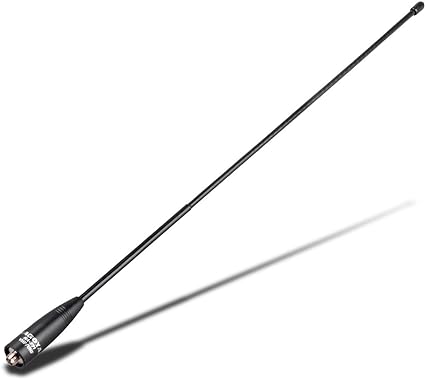
The NA-771 remains one of the easiest upgrades to recommend to somebody who bought a UV-5R, BF-F8HP or similar radio and does not want the accessory to cost nearly as much as the handheld.
BTECH’s current Nagoya listing specifies a 15.6-inch, 50-ohm, 2 m/70 cm antenna rated for 10 W, with its optimum transmit ranges covering the U.S. amateur portions of 2 m and 70 cm.
Its appeal is value rather than exotic engineering. Screw the genuine antenna directly onto a compatible radio, compare the same repeater from the same location, and see whether the longer radiator solves enough of the problem.
Counterfeits remain worth mentioning because Nagoya is one of the antenna names frequently copied in marketplace listings. The link here points to the established BTECH/Nagoya Amazon listing rather than a generic look-alike.
The limitation has not changed: 15.6 inches is a lot of antenna on a tiny HT. If you constantly bend or catch antennas on bags and clothing, the Signal Stick below is the more interesting alternative.
Best for: UV-5R/BTECH-style owners who want a low-cost full-length dual-band upgrade.
Skip it if: your radio uses the opposite connector, you need 1.25 m transmit coverage, or flexibility is your main priority.
3. Super-Elastic Signal Stick

The Signal Stick belongs in this guide because it solves a different problem from the Diamond and Nagoya: durability.
Signal Stuff builds the dual-band version from flexible Nitinol and currently lists it at roughly 19 inches long. It is a quarter-wave design on 2 m and functions as a three-quarter-wave antenna on 70 cm.
It is exceptionally light, which matters because a long heavy antenna can place more stress on a handheld’s SMA connector. Signal Stuff also backs the Signal Stick antenna line with a lifetime warranty.
Connector choice is another strength. Signal Stuff currently offers SMA-F, SMA-M and BNC versions, so there is little reason to build an adapter stack if the correct direct-fit antenna is available.
I am not ranking it above the Diamond because Wholly Outdoor’s first-hand antenna comparisons did not include it. Instead, I would choose it when the way you carry the radio makes a highly flexible, difficult-to-damage whip more valuable than repeating the existing Diamond-versus-Nagoya test.
Best for: backpacks, events, hiking and operators who repeatedly bend or snag conventional whips.
Skip it if: you specifically want a proven Wholly Outdoor-tested winner rather than the durability-focused path.
4. Nagoya NA-320A
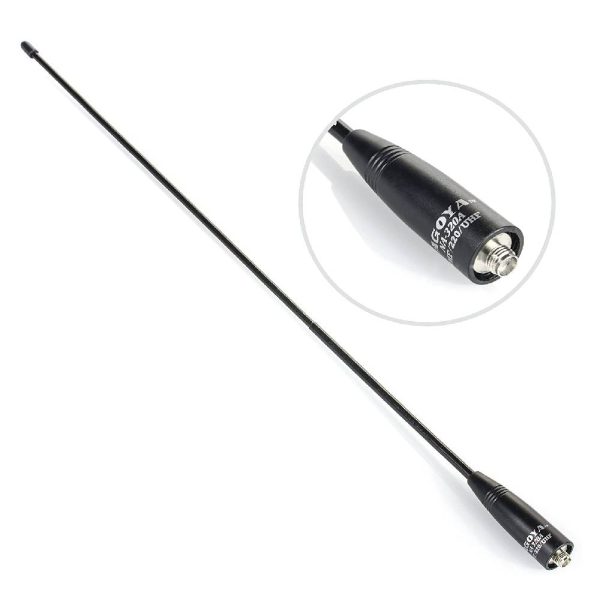
A dual-band antenna is not the right recommendation when the reason you bought the handheld was its 1.25-meter transmit capability.
BTECH currently specifies the NA-320A for 144, 225 and 430 MHz operation, with optimum transmit ranges covering 2 m, 1.25 m and 70 cm amateur bands. It is approximately 17.7 inches long and uses the same SMA-F family as many BTECH/Baofeng radios.
This makes it the better fit for tri-band handhelds such as the BF-F8HP Pro or BTECH UV-5X3 when 220 MHz is a real operating goal rather than a feature you never use.
Do not buy it merely because three bands sound better than two. If you only transmit on 2 m and 70 cm, the simpler Diamond, NA-771 or Signal Stick paths remain the cleaner choices.
If you have not decided whether you need a dual-band or tri-band HT yet, compare the radios first in our handheld radio guide.
Best for: compatible tri-band handhelds when 1.25 m/220 MHz transmit operation genuinely matters.
Skip it if: your handheld is dual-band only or your local activity is almost entirely 2 m/70 cm.
5. Nagoya UT-72 Magnetic-Mount Antenna
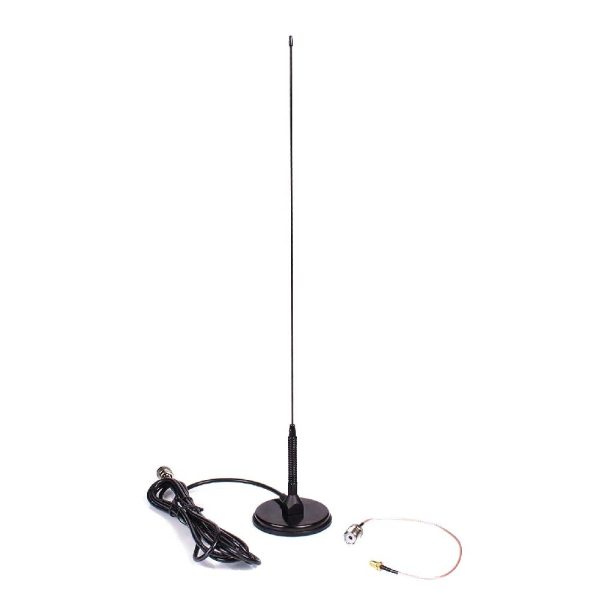
If the handheld spends most of its time inside a car, I would stop comparing rubber-duck replacements and move the antenna outside.
Nagoya currently specifies the UT-72 as a dual-band magnetic-mount antenna approximately 20 inches tall, with 13 feet of RG-58A/U coax and a PL-259 connector. The package also includes an adapter aimed at the common BTECH/Baofeng handheld route.
The important improvement is not a claimed gain figure. It is placement. The radiator sits outside the passenger compartment on a suitable metal surface rather than being surrounded by the vehicle body and whatever position your hand happens to hold the radio in.
A magnetic mount is also still a compromise. A permanent mobile installation can give you a more robust mount, cleaner cable routing and a proper mobile radio. Once you reach that point, continue to our best mobile ham radio guide.
Best for: handheld users who regularly operate from a vehicle and want a simple removable external antenna.
Skip it if: you need a walking-around antenna or your vehicle does not provide a suitable metal mounting surface.
6. N9TAX Dual-Band Slim Jim

The N9TAX is the recommendation that changes the problem completely. Instead of asking how good an antenna can be while screwed directly onto your handheld, it lets you put the antenna higher and feed it with coax.
The current dual-band version covers 144–148 MHz and 440–450 MHz, uses ladder-wire construction, incorporates a trapped UHF section and a ferrite choke on the integrated cable, and is rated by N9TAX for up to 100 W.
None of those details matter as much as the installation opportunity: throw a support line into a tree or hang the antenna from a suitable mast and the radiating element can be well above head height.
That aligns with ARRL’s VHF advice. Height is one of the strongest levers you have because VHF/UHF communication is heavily influenced by radio horizon and obstructions. A modest antenna fifteen feet higher can solve a problem that another screw-on whip does not.
This is especially logical for POTA, SOTA, camping or emergency-style stationary operation where you can take a few minutes to deploy an external antenna.
Best for: portable operators who stop in one location and can hang an antenna above them.
Skip it if: you need to walk around continuously with the radio in your hand.
7. Comet SMA-24J
The Comet remains worth keeping because Wholly Outdoor has actually used it and because it occupies a slightly different handling niche.
Comet currently lists the SMA-24J as a 15.75-inch dual-band whip with an SMA-F connector, rated for 20 W. Its defining characteristic is its very thin, flexible construction rather than a claim that it simply beats every other antenna.
Our previous testing found that light flexible feel pleasant while walking around, particularly on 70 cm, but the base felt less confidence-inspiring for rough treatment and the 2 m improvement was less compelling than the strongest alternatives.
So I would keep it as a handling-driven alternative rather than move it into the top three.
Best for: operators who want a long conventional whip that feels unusually light and unobtrusive.
Skip it if: outright all-round performance or extreme bend resistance is more important than low weight.
Height Can Beat a Better Handheld Whip
One of the easiest mistakes in this category is assuming that “better range” is exclusively an antenna-model problem.
VHF and UHF are strongly affected by terrain, structures and radio horizon. ARRL’s Find a High Spot for VHF specifically recommends gaining elevation and improving the handheld antenna before simply chasing more transmitter power.
↓
SAME RADIO + SAME WHIP OUTSIDE
↓
SAME RADIO + SAME WHIP ON HIGH GROUND
↓
SAME RADIO + EXTERNAL ANTENNA HUNG HIGH
That progression is why the N9TAX belongs on this page even though it is not a replacement whip. Once you stop walking, moving the antenna higher can become the larger upgrade.
You can also build this type of external solution yourself. ARRL publishes a portable ground-plane antenna project for handheld use if you would rather build than buy.
2 m / 70 cm Is Not the Same as Tri-Band
Most antennas on this page are optimized for the two amateur bands most new Technician-class operators use: 2 meters and 70 centimeters.
That is fine until the radio itself also transmits on 1.25 meters.
If you own a tri-band handheld such as the BF-F8HP Pro or UV-5X3 specifically because you want 220 MHz operation, use an antenna that is designed for that band as well. The NA-320A exists for exactly that reason.
Do not assume that because a dual-band antenna happens to receive a third frequency it is automatically appropriate for transmitting there.
Check RepeaterBook before spending extra on a third-band antenna. If there is essentially no 1.25 m activity in your area, a better 2 m/70 cm antenna may remain the smarter purchase.
Longer Is a Tradeoff, Not an Automatic Win
The stock rubber antenna is physically compromised to make the handheld compact. Moving to a 15–19-inch antenna can give the radio a much more useful radiator, but the improvement comes with handling costs.
A long whip:
- catches on clothing and bags more easily;
- creates more leverage at the radio’s antenna connector;
- can make a tiny radio top-heavy;
- may be annoying enough that you stop carrying the radio.
This is why antenna choice is not simply a ranking from shortest to longest.
If your HT is primarily an emergency or local-event radio that lives on your belt, a slightly less efficient antenna that you actually carry can be a better system than a very long whip that stays at home.
Why a Better Antenna Can Sometimes Make Reception Worse
This sounds backwards, but it is real.
Some inexpensive handheld receivers have limited filtering in strong-signal environments. A more effective antenna pulls in more wanted signal—but it also delivers stronger nearby broadcast, commercial and other RF signals to the receiver.
Signal Stuff documents this behavior specifically with some Baofeng radios: a better antenna can expose receiver overload and make a wanted signal seem weaker because the front end is being overwhelmed.
Their Signal Stick technical FAQ explains the effect in more detail.
If strong-signal handling is becoming the radio’s limitation, the better next purchase may be the radio itself. See our handheld radio comparison rather than buying increasingly elaborate antennas for a receiver that cannot use the extra signal.
Using a Handheld in a Vehicle
A vehicle creates one of the clearest upgrade paths on the page.
The handheld’s whip is surrounded by the car body, positioned low, and often held inside the passenger compartment. Moving the radiator outside onto a suitable vehicle surface changes that geometry immediately.
That is why I would buy the UT-72 before spending similar money trying several additional handheld whips for car use.
Once the vehicle setup becomes permanent, the next step is no longer another HT accessory. A properly installed mobile antenna, fused wiring and a higher-power mobile radio make more sense.
ARRL’s broader VHF/UHF antenna overview is also useful for understanding why omnidirectional mobile antennas are normally used for vehicle communication.
For Home Use, Stop Treating the Handheld Like a Handheld
If the radio spends most of its life on a desk, the best antenna upgrade is usually not attached to the top of the radio.
A properly installed outdoor VHF/UHF base antenna placed higher and in the clear can change far more than switching between several replacement whips.
Continue to our VHF/UHF base antenna guide if that describes your operating style.
Once the antenna moves away from the radio, feedline loss becomes part of the station—especially at 70 cm. Our coax and connectors guide explains why the cable that is acceptable on HF may not be the cable you want for a longer UHF run.
Should You Measure SWR on a Handheld Antenna?
You can, but handheld antennas are unusually sensitive to how they are measured.
The radio body, your hand and the objects around the antenna form part of the real operating environment. Signal Stuff notes that measured SWR can change substantially when you alter the meter, feed arrangement or counterpoise.
For a simple direct-fit whip, real-world repeater performance is often more useful than obsessing over a bench number.
External antennas are different. If you install a magnetic mount, roll-up antenna or permanent base system and want to troubleshoot it properly, our SWR meter and antenna analyzer guide explains when measurement becomes useful.
What to Avoid
- Do not buy by advertised gain alone. Handheld antenna measurements depend heavily on the radio, environment and reference used.
- Do not order an SMA antenna from a photograph. Verify the exact radio-model compatibility.
- Do not assume longer is always better. Handling, connector stress, band tuning and receiver overload still matter.
- Do not buy a dual-band antenna for 220 MHz transmit use. Use a suitable tri-band or 1.25 m antenna when that band matters.
- Do not keep buying HT whips for a car problem. Put an antenna outside the vehicle.
- Do not keep buying HT whips for a home-station problem. Move to an external/base antenna where practical.
- Do not blame the antenna for a programming error. Wrong offset, tone or repeater settings can look exactly like poor range.
- Do not ignore receiver overload. A better antenna can expose limitations in an inexpensive receiver near strong RF sources.
- Do not put unnecessary adapter stacks directly under a long whip. Use the correct direct-fit version where one exists.
Continue Improving Your VHF/UHF Station
If receiver quality or features are now the limiting factor, compare the radio rather than buying another antenna.
Fix repeater frequency, offset and tone problems before assuming the RF hardware is at fault.
See where a handheld, roll-up antenna or full HF portable station makes sense outdoors.
Move beyond the HT once a vehicle installation becomes permanent.
Height and outdoor placement become the priority for a home repeater station.
Feedline becomes part of the decision as soon as the antenna moves away from the handheld.
Learn how to test external VHF/UHF antennas without mistaking one SWR number for the whole story.
Spare batteries, speaker microphones, cases and other additions that may matter more than another antenna.
Handheld Antenna FAQ
What is the best antenna for a Baofeng UV-5R?
For value, I would start with the genuine Nagoya NA-771. The Diamond SRJ77CA is the more performance-focused direct whip recommendation here, while the Signal Stick makes more sense if flexibility and durability are priorities.
What antenna should I use on a Yaesu FT-65R or FT-70DR?
The Diamond SRH77CA is the direct-fit 77CA version recommended here. Do not order the nearly identical SRJ77CA simply because the names look similar—the connector version matters.
What antenna should I use with a BF-F8HP Pro for 1.25 meters?
If you intend to transmit on 1.25 m/220 MHz as well as 2 m and 70 cm, use a tri-band antenna such as the Nagoya NA-320A rather than a dual-band-only NA-771 or Diamond 77CA.
Signal Stick or Nagoya NA-771?
Choose the NA-771 when low cost is the priority. Choose the Signal Stick when flexibility, low weight and resistance to repeated bending matter more. Both still need the connector version that fits your exact radio.
Is a longer handheld antenna always better?
No. A properly designed longer radiator can improve performance compared with a compact rubber antenna, but convenience, connector leverage, band tuning and receiver overload still matter. An antenna you stop carrying is not an upgrade in practice.
Why can I hear a repeater but not transmit into it?
It may not be an antenna problem. Verify the input frequency, offset and access tone first. Our programming guide covers those settings.
What is the best handheld antenna for a car?
I would generally move to an external vehicle antenna rather than another screw-on whip. The Nagoya UT-72 is the simple magnetic-mount choice here for compatible handhelds.
Is a roll-up J-pole or Slim Jim better than a handheld whip?
It can be when you are stationary because you can hang it well above the radio and reduce the effect of surrounding obstructions. It is not a replacement for a whip while walking because it requires coax and a support point.
Can a better antenna make a Baofeng receive worse?
Yes, in a strong-RF environment. Some receivers can overload when a more effective antenna delivers much stronger unwanted signals to the front end. Test from another location before assuming the new antenna is defective.
Useful Antenna Resources
- ARRL — Find a High Spot for VHF — why height, terrain and radio horizon matter so much to handheld range.
- ARRL — VHF and UHF — background on omnidirectional, J-pole, ground-plane and directional antennas.
- ARRL — Portable Ground-Plane Antenna Project — a DIY external antenna option for 146, 223 or 440 MHz.
- Signal Stuff — Signal Stick Compatibility & Technical FAQ — connector options, receiver-overload explanation and real-world SWR notes.
- N9TAX Labs — Technical Information — background on its roll-up Slim Jim design.
- RepeaterBook — check which VHF/UHF bands and nearby repeaters you actually need to reach before buying.
Licence note: You do not need equipment to take an amateur-radio exam. Transmitting requires the appropriate amateur-radio licence and operating privileges for the frequency you use.
Wholly Outdoor is not affiliated with the FCC, NCVEC, ARRL, Diamond Antenna, BTECH, Nagoya, Signal Stuff, N9TAX Labs or Comet Antenna.