
Best Shortwave Radios with SSB in 2026
As an Amazon Influencer, we earn from qualifying purchases you might make if you click any of the links or buttons on this page.
The best shortwave radio with SSB in 2026 is the Tecsun PL-520 for most people buying fresh. It already gives you USB and LSB, 10 Hz fine tuning and useful voice filters. Spend more when you need easier hands-on tuning, a serious external-antenna station, or a compact radio that also covers weather and aviation.
Last reviewed: September 24, 2026.
Quick Picks
Tecsun PL-520
Compact, direct entry, 10 Hz USB/LSB tuning, five SSB filters and USB-C charging. Start here unless another requirement changes the choice.
Switch to PL-330: if the older radio is substantially cheaper from a seller you trust.
Tecsun PL-880
Separate main and fine tuning, a fuller speaker, external shortwave antenna input and Local/Normal/DX gain selection make long SSB sessions more comfortable.
Tradeoff: larger and less convenient to carry than the PL-520.
Tecsun S-2200x
Dedicated antenna inputs, variable RF gain and attenuation give you more control when a substantial external antenna is part of the station.
Tradeoff: size and cost make little sense for occasional whip-antenna listening.
Compare the SSB Radios
| Radio | Best reason to buy it | SSB tuning | Power | Main limit |
|---|---|---|---|---|
| Tecsun PL-520 | Best fresh purchase for most | USB/LSB; 10 Hz fine steps; five SSB filters | BL-5C; USB-C charging | One multifunction tuning control; small speaker |
| Tecsun PL-330 | Best value when discounted | USB/LSB; 10 Hz fine steps; five SSB filters | BL-5C; check the listing’s charging port | Smaller controls and no built-in kickstand |
| Tecsun PL-880 | Long manual listening sessions | USB/LSB; 10 Hz fine steps; dedicated fine control | 18650 rechargeable cell | Bulkier than the compact pair |
| Tecsun S-2200x | Fixed station with an external antenna | USB/LSB; 10 Hz fine steps; multiple filters | Two 18650 cells or four D cells | Large and expensive |
| C.Crane CC Skywave SSB 2 | Small travel radio with weather and airband | USB/LSB; 10 Hz fine steps; selectable filters | Two AA alkaline or NiMH cells | You pay for features beyond HF SSB |
| Sangean ATS-909X2 | Larger AA-powered all-band portable | USB/LSB; direct entry and fine tuning | Four AA cells or external DC | Costly if SSB alone is the goal |
1. Tecsun PL-520 — Best Shortwave Radio with SSB for Most People
The PL-520 is where I would start for a new SSB listener. It tunes upper and lower sideband in 10 Hz fine steps, and its five SSB bandwidth choices are 0.5, 1.2, 2.2, 3.0 and 4.0 kHz. Narrow the filter when a nearby signal crowds a voice; open it when conditions allow better speech quality.
Direct frequency entry is helpful when a club, frequency list or another listener gives you a specific number. The FM/shortwave antenna jack leaves room for a small external antenna later. ETM+ is helpful for exploring broadcasts, though it is not a replacement for manually finding intermittent ham SSB conversations.
What changed from the PL-330?
The PL-520 has USB-C charging, a rear kickstand, a Favorites key and a somewhat easier control layout. The two radios already share the important SSB basics: sideband selection, 10 Hz fine tuning and five voice-filter widths. Check the exact PL-330 listing before using the charging connector as a deciding factor: current seller descriptions differ on whether a particular PL-330 package uses micro-USB or USB-C. The PL-520’s handling improvements make it nicer to buy and use; I would not promise a dramatic SSB reception upgrade over a healthy PL-330.
Both use a BL-5C rechargeable battery rather than ordinary AA cells. The PL-520’s charging socket is convenient, but a charging cable is not a substitute for a charged cell when there is no power source. Check the package and USB charger requirements for the version your seller supplies.
Best for: a first serious shortwave portable, casual ham-voice listening and travel when NOAA weather is not essential. Skip it if: you already own a working PL-330, or you know you will spend hours manually tuning SSB each week.
2. Tecsun PL-330 — Best SSB Value When Cheaper
The PL-330 still has the fundamentals that make an inexpensive SSB radio genuinely useful: direct entry, separate USB and LSB modes, 10 Hz fine tuning, five SSB bandwidth settings, and a 3.5 mm external FM/shortwave antenna jack.
It also has synchronous detection for AM broadcasts and ETM+ scanning. Those are useful for general shortwave listening, but the purchasing decision here is much simpler: compare the actual seller and total price with the PL-520. If the PL-330 is roughly 20% less, I would normally save the money. If they are close, I would take the PL-520’s kickstand, Favorites key and updated ergonomics. Verify the charging connector on the actual PL-330 listing rather than relying on an older general comparison.
Neither model is a substitute for a bigger tuning control if your main activity is following many ham conversations for long sessions. And if you own a PL-330 already, first spend time on antenna placement and household noise before paying to replace it.
Best for: budget-minded listeners who still require real SSB controls. Skip it if: the PL-520 costs nearly the same from a reliable seller.
3. Tecsun PL-880 — Best for Frequent SSB Tuning
If SSB becomes the main thing you listen to, the PL-880’s separate coarse and fine tuning controls are the reason to move up. You can search around the band and then bring a voice into tune without repeatedly switching the function of one small control.
You also get a more comfortable speaker for long listening, an external shortwave antenna jack and a Local/Normal/DX antenna gain switch. The gain switch gives you a basic way to back off when a larger antenna or strong nearby signals make reception worse. It is less flexible than the S-2200x’s antenna and RF controls, but it is enough for many portable setups.
The PL-880 does not earn its place because the PL-520 somehow lacks SSB. It earns it because an hour of manual tuning feels different on larger dedicated controls. If you mostly type a known frequency and listen for a few minutes, the compact radio remains a better value.
Best for: regular amateur and utility voice monitoring with hands-on tuning. Skip it if: the receiver needs to be pocketable or you only occasionally try SSB.
4. Tecsun S-2200x — Best Traditional Home SSB Receiver
Buy the S-2200x when the antenna system is the project. Tecsun provides a 50-ohm BNC shortwave input for a suitable feed line, separate high-impedance wire terminals, external antenna selection, variable RF gain and an input attenuator. These controls become useful when a larger outdoor antenna supplies too much strong-signal energy as well as the weak signals you want.
It also offers USB/LSB, 10 Hz SSB fine tuning, selectable filters and large tuning controls. The maker lists two 18650 cells or four D cells as power options. It covers more than HF, including the VHF aviation band, but its advantage in this comparison is control over the external shortwave antenna path.
That does not mean a larger box automatically receives an SSB signal that a PL-520 cannot. If your listening is mostly from a telescoping whip or a modest reel wire, you are paying for inputs and controls you may rarely use. The S-2200x is also over five pounds before batteries.
Best for: a fixed listening position with an intentionally planned outdoor receive antenna. Skip it if: your radio must travel, or you have not yet solved local electrical noise. Before checkout, confirm the listing is the S-2200x; some Amazon results use the similar “S-2200” name.
5. C.Crane CC Skywave SSB 2 — Best Small Travel and Weather Choice
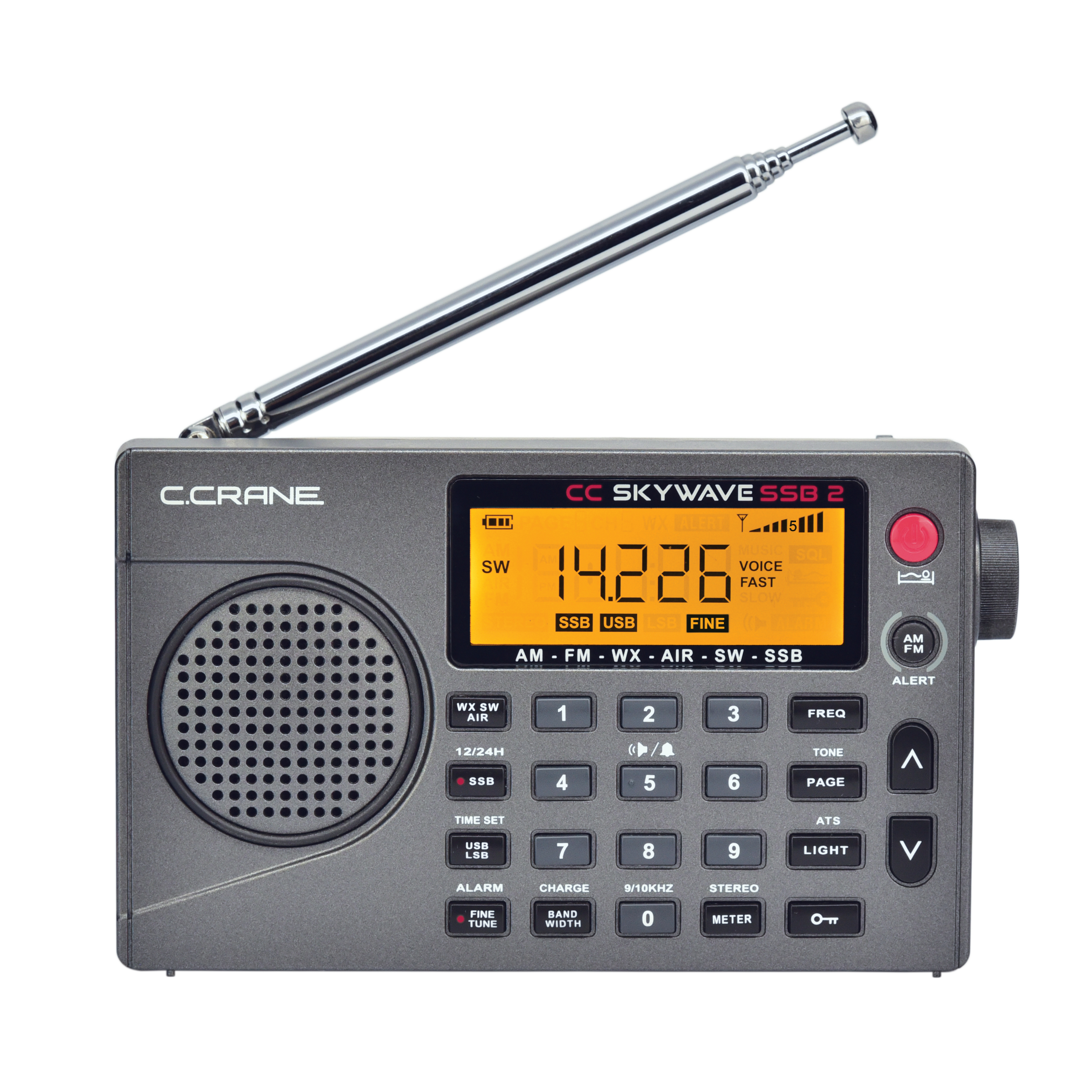
The Skywave SSB 2 makes sense when the same receiver must go in a travel bag and also provide more than shortwave. It adds NOAA Weather Radio with alert and VHF civilian aviation reception while weighing about six ounces without batteries. It takes two AA alkaline or NiMH cells, and C.Crane rates approximately 60 hours with the speaker or 70 with earbuds on alkaline batteries.
For SSB, you still get direct frequency entry, USB/LSB selection and 10 Hz fine tuning. The package includes a 23-foot shortwave reel antenna, wire-terminal adapter, earbuds and a case. C.Crane’s reel clips to the whip; the separate antenna jack and adapter are another connection path. Check which accessory you are using before trying to plug the reel into the jack.
Best for: a very small, replaceable-battery SSB radio when NOAA and airband also matter. Skip it if: you only need SSB shortwave and would rather spend less on the PL-520. See our emergency radio guide for its preparedness role.
6. Sangean ATS-909X2 — Best Larger AA-Powered Alternative
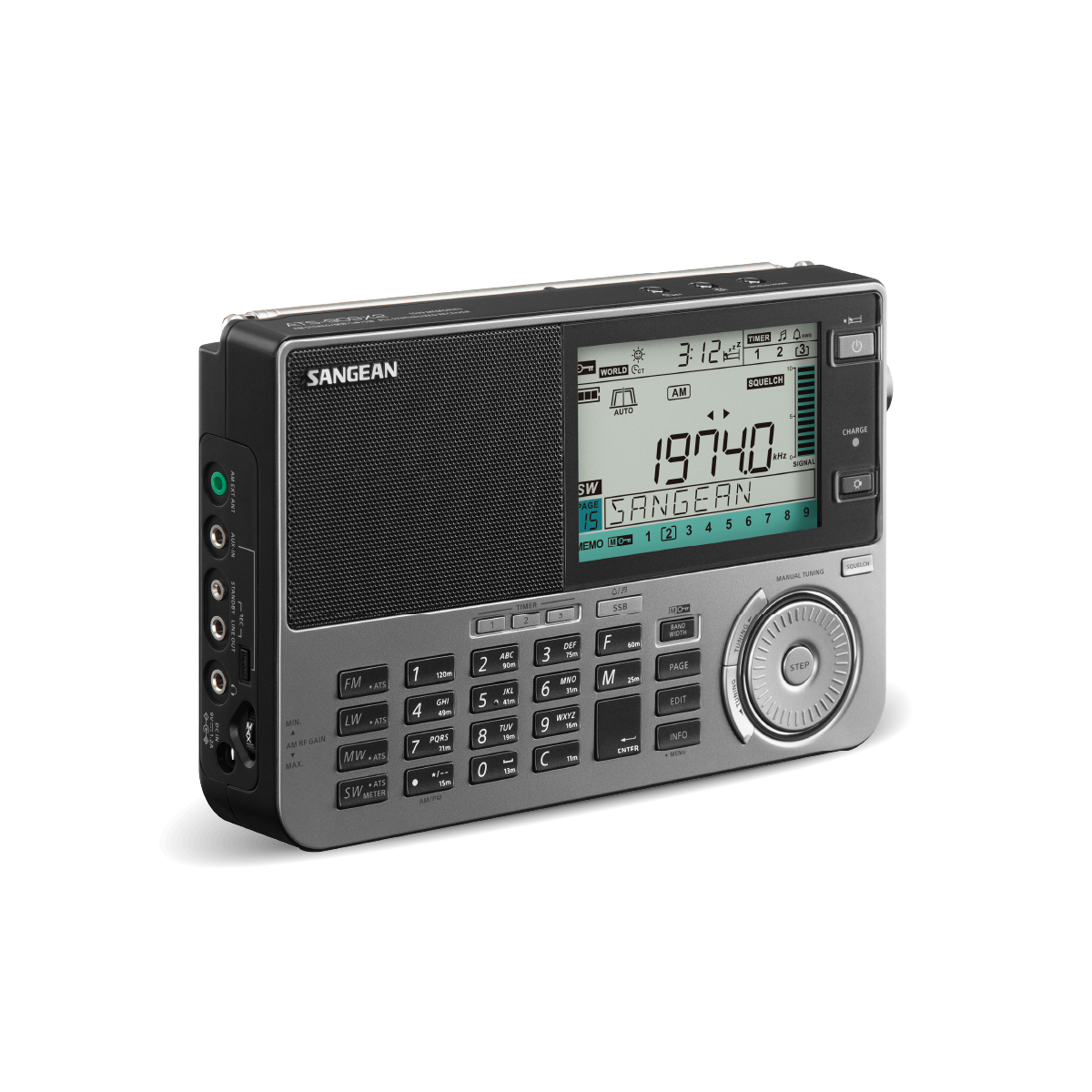
The ATS-909X2 is the alternative when you want a larger portable with four ordinary AA cells, a bigger interface, shortwave SSB and airband. Sangean also includes direct tuning, external shortwave antenna support, RF gain control and extensive station memories. Its larger keys and display may be easier to use than a pocket radio.
I would not pay its premium for SSB reception alone; the PL-520 already decodes amateur voice. Buy it for the whole interface, AA power and extra bands. Sangean has also published documentation for revised ATS-909X2-family models, so verify the exact suffix and features of any listing before assuming that an X2, X2+ or X2SE is the same unit.
Best for: someone who wants serious portable listening and standardized AA power. Skip it if: you want only a compact HF SSB receiver or already prefer the PL-880’s independent tuning knobs.
Why the Tecsun PL-990x Did Not Win
The PL-990x adds a larger feature set, including more memories, additional antenna selection and audio playback features. It can be an appealing all-around portable. But if the specific job is listening to HF SSB for long periods, I would first buy the PL-880’s straightforward controls. If the two are unusually close in price where you shop, compare the PL-990x extras you will actually use. I cannot justify claiming it receives SSB signals better without a controlled comparison.
Watch the Wholly Outdoor SSB Comparison
The video explains the same buying decision: start with a capable compact receiver, then pay for tuning ergonomics, antenna control or travel features only when one of them is needed.
How to Choose an SSB Shortwave Radio
USB and LSB are modes, not extra bands
An AM-only radio can tune to an amateur voice frequency and still make the speech sound distorted or unintelligible. An SSB-capable receiver selects upper or lower sideband to recover that signal. General convention is LSB on many amateur bands below 10 MHz and USB on higher amateur bands, but follow the actual signal and frequency plan. You do not need an amateur license simply to listen; transmitting is a separate licensed activity.
Fine tuning makes voices understandable
A 1 kHz frequency step can leave a voice sounding too high or too low. Fine tuning in 10 Hz steps lets you move toward natural speech. Do not confuse display resolution with a promise of perfect calibration or better weak-signal performance.
Bandwidth controls help with interference
Try a wider SSB filter for a clean, readable voice. Narrow it when a nearby signal interferes, accepting thinner audio. A very narrow setting can also help isolate a tone or Morse code. Five filters on an affordable radio are useful; they do not guarantee that a weak station will become audible in a noisy room.
Match antenna controls to the antenna
Begin on the telescoping whip outdoors or in a quieter part of the house. A small reel can help; a long outdoor wire may also deliver strong signals that overload a portable radio. If adding an antenna makes the signal meter rise but speech gets worse, test the location, noise sources and gain setting before buying an even bigger antenna. See our shortwave antenna guide for that decision.
Your First SSB Listening Session
- Run the radio from batteries and move away from chargers, LED lamps, routers and computer screens.
- Use a current amateur band plan or a known active frequency from a local club or listener community. Activity changes by place, time and propagation; no single frequency is guaranteed.
- Enter the frequency, switch from AM to SSB, then choose USB or LSB as appropriate.
- Fine-tune until speech sounds natural. Try a wider filter first, then narrow it if adjacent interference is a problem.
- If you hear nothing, try another time or band and compare reception outside before blaming the receiver.
Which SSB Radio Should You Buy?
Most new buyers
Choose the PL-520. Choose the PL-330 if it is substantially cheaper.
Long listening sessions
Choose the PL-880 for its separate tuning controls and larger speaker.
A planned home antenna
Choose the S-2200x for its antenna connections and RF controls, after addressing local noise.
Tiny travel kit
Choose the CC Skywave SSB 2 when AAs, NOAA and aviation reception matter.
Large AA portable
Consider the Sangean ATS-909X2 when you want its interface and additional bands.
Related Wholly Outdoor Guides
SSB Shortwave Radio FAQ
What is the best shortwave radio with SSB in 2026?
The Tecsun PL-520 is my default for a new purchase. It covers both sidebands with 10 Hz fine tuning and five SSB bandwidth settings. The PL-330 can be the better value if its price is substantially lower.
Do I need a ham radio license to listen to SSB?
No U.S. amateur-radio license is needed simply to receive amateur transmissions. A license and the appropriate privileges are required to transmit on amateur frequencies.
Does a shortwave radio with SSB transmit?
No. Every radio in this guide is a receiver. “SSB” here means it can demodulate SSB signals, not that it can talk to other operators.
Is the PL-520 a big reception upgrade over the PL-330?
That is not a claim I would make. They share the essential SSB controls. The PL-520’s clearer buying advantages are its kickstand, Favorites key and updated handling; check the seller’s PL-330 charging-port description because versions and listings differ. Keep a working PL-330.
Why buy the PL-880 instead of the PL-520?
Choose the PL-880 if you regularly search the ham bands by hand and want separate main and fine-tuning controls, a fuller speaker and a basic antenna gain selector.
When is the S-2200x worth it?
When you are building a fixed listening station around a suitable external antenna and will use its separate inputs, RF gain and attenuation. For occasional listening on a whip, a smaller radio makes more sense.
Does the CC Skywave SSB 2 receive NOAA Weather Radio?
Yes. It includes NOAA Weather Radio with alert as well as SSB shortwave and civilian aviation reception. The alert function draws significant battery power while monitoring.
Which sideband should I select?
Use the mode specified for the signal. Many amateur voice contacts below 10 MHz use LSB, while higher amateur HF bands commonly use USB. Switch modes and fine-tune if the speech is not intelligible.