
Best Handheld Ham Radios for Beginners (2026)
For a simple first analog handheld, get the Yaesu FT-65R. Choose the BF-F8HP Pro for more bands and features, or the FT-70DR if your local repeaters use System Fusion.
Quick Picks
These are still the three handhelds I would start with for the most common beginner decisions. The expanded guide below covers APRS, advanced System Fusion, D-STAR and strong-RF environments.
Yaesu FT-65R
The first radio I would choose when the goal is reliable 2 m and 70 cm analog repeater operation without paying for digital modes you may never use.
- + Straightforward analog FM operation
- + IP54 construction, 1 W speaker and current Yaesu support
- − Computer programming requires a separate cable
Baofeng BF-F8HP Pro
Buy it for 1.25 m, GPS, 1,000 memories, airband receive and USB-C—not simply because the advertised wattage is higher.
- + 2 m, 1.25 m and 70 cm amateur operation
- + GPS, USB-C charging, zones and firmware updates
- − More menus and features than a first repeater contact requires
Yaesu FT-70DR
The right first digital handheld when the repeaters and operators around you actually use Yaesu C4FM System Fusion.
- + Analog FM and C4FM digital in one radio
- + Automatic Mode Select and 700 mW front speaker
- − Its defining feature is wasted if your local activity is analog-only
Compare the Best Handheld Ham Radios
| Radio | Best For | Transmit Bands | Digital / Data | Programming | Main Tradeoff | Action |
|---|---|---|---|---|---|---|
| Yaesu FT-65R | Simple first analog radio | 2 m / 70 cm | Analog FM | Yaesu / CHIRP Cable extra |
No digital voice or USB-C charging | Current price → |
| Baofeng BF-F8HP Pro | More bands & features | 2 m / 1.25 m / 70 cm | Analog FM + GPS | BTECH / CHIRP PC03 extra |
Feature-heavy for a basic first radio | Current price → |
| Yaesu FT-70DR | Entry to System Fusion | 2 m / 70 cm | C4FM + analog FM | ADMS-10 / CHIRP | Fusion adds little if nobody nearby uses it | Current price → |
| BTECH UV-PRO | Analog APRS & app programming | 2 m / 70 cm | APRS, GPS, Bluetooth KISS | Phone app / CSV | Only 180 memories across six banks | Current price → |
| Yaesu FT5DR | Advanced Fusion & APRS | 2 m / 70 cm | C4FM, APRS, GPS | ADMS-14 | Far more radio than most beginners need | Manufacturer → |
| Icom ID-52A PLUS | D-STAR path | 2 m / 70 cm | D-STAR + FM, GPS | Icom software / USB-C | Premium purchase if D-STAR is not locally useful | Manufacturer → |
| Yaesu FT-60R | Traditional analog alternative | 2 m / 70 cm | Analog FM | Traditional cable/software workflow | Older NiMH battery/charging system | Manufacturer → |
Swipe to compare →
Which Handheld Should You Buy?
Our Handheld Ham Radio Picks in Detail
1. Yaesu FT-65R

If a newly licensed Technician asks me for one handheld whose main job is getting onto local analog repeaters, the FT-65R remains the easiest recommendation on this page to justify.
Yaesu still lists it in its current handheld lineup. It is a conventional 2 m/70 cm analog FM transceiver with selectable 5, 2.5 and 0.5 W output, a one-watt front speaker and a supplied 1950 mAh Li-ion battery. Yaesu also offers a 2500 mAh replacement/upgrade battery.
More importantly, its simplicity matches the beginner job. You can spend your first weeks learning repeater offsets, CTCSS/DCS tones, memory channels, simplex operation and proper radio procedure rather than learning an entire digital network first.
Programming remains its clearest inconvenience. Yaesu’s current accessory list still points to the SCU-35 programming cable, so computer programming adds another purchase. Our radio programming guide explains that workflow before you order the cable.
I also would not replace the FT-65R merely because newer inexpensive radios advertise more transmit power. Yaesu itself notes that the same handheld can go from very limited ground-level range to dramatically longer communication from elevation. That is why antenna placement and elevation remain more important than chasing a few extra watts.
Best for: a beginner who wants a rugged, uncomplicated analog handheld for local repeater and simplex operation.
Skip it if: you specifically need 1.25 m, APRS or a digital-voice ecosystem.
2. Baofeng BF-F8HP Pro
The BF-F8HP Pro is for the beginner who already knows that a bare-bones dual-band radio will feel limiting.
BTECH currently specifies amateur transmit coverage on 2 m, 1.25 m and 70 cm. It also provides 1,000 programmable memories arranged into ten zones, GPS, aviation AM receive, NOAA weather functions, USB-C battery charging and a color display.
The software story is also much stronger than on many anonymous low-cost handhelds. BTECH maintains its CPS and firmware, and the current CHIRP supported-radio list includes the BF-F8HP Pro. If you want to build organized zones for home, travel, repeaters and monitoring, that matters more than another marketing number on the box.
Notice what I am not using as the reason to buy it: output power. BTECH’s current product page advertises 10 W on VHF/UHF, but even if you compare that headline with a conventional 5 W handheld, you should not expect twice the practical range.
If range is the reason you are shopping, first test outdoors or at elevation and then consider the handheld antenna upgrade guide.
Best for: beginners who want tri-band amateur operation, lots of memories, GPS, USB-C and room to experiment.
Skip it if: you want the simplest possible path to a few local analog repeaters.
Watch Our BF-F8HP Pro Review
We have a dedicated Wholly Outdoor review of the same BF-F8HP Pro. Use it for a closer look at the radio itself after deciding whether this feature-rich analog path actually fits you.
3. Yaesu FT-70DR
The FT-70DR remains the right beginner digital recommendation when your local infrastructure answers the question for you: people around you use Yaesu System Fusion.
Yaesu still lists it in the current handheld line. It combines ordinary analog FM with C4FM digital operation, provides up to 5 W transmit power and uses Automatic Mode Select to recognize whether an incoming signal is analog FM or C4FM.
That makes it a much better recommendation than calling it a generic “premium” handheld. If your club operates Fusion repeaters, one radio can cover both analog and C4FM use without requiring you to replace your first HT a few months later.
If every repeater you care about is analog, however, I would save the money and buy the FT-65R. And if you have not decided whether your area favors C4FM, D-STAR or DMR, read our DMR vs D-STAR vs System Fusion guide before choosing the radio.
Best for: new operators whose local club or repeater network actively uses Yaesu System Fusion.
Skip it if: your local activity is analog-only or another digital ecosystem dominates your area.
4. BTECH UV-PRO
The UV-PRO is the radio I would add for somebody who looks at an ordinary analog HT and thinks, “I want APRS, GPS and easier phone-based setup, but I do not need a digital-voice ecosystem.”
BTECH currently gives it IP67 protection, onboard GPS, APRS operation, Bluetooth KISS TNC support, USB-C charging, NOAA alerts and AM airband reception. Its programming app supports CSV import/export, which makes building and moving channel plans much less tedious than repeated front-panel entry.
Importantly, the radio remains usable without the phone. Analog voice, scanning, GPS and APRS are radio functions; the phone makes programming, mapping and some workflows easier.
The limitation is memory capacity. BTECH organizes 180 channels into six banks of 30. That may be plenty for a local and travel plan, but the BF-F8HP Pro’s 1,000-memory/ten-zone structure is far more comfortable if you intend to load large regional repeater databases.
This is also where the distinction between analog APRS and digital voice matters. If your actual goal is Fusion, D-STAR or DMR, do not buy the UV-PRO simply because it is technologically sophisticated.
Best for: analog operators who specifically want APRS/GPS, Bluetooth and app-based programming.
Skip it if: you want 1.25 m, very large channel banks or a digital-voice mode.
5. Yaesu FT5DR
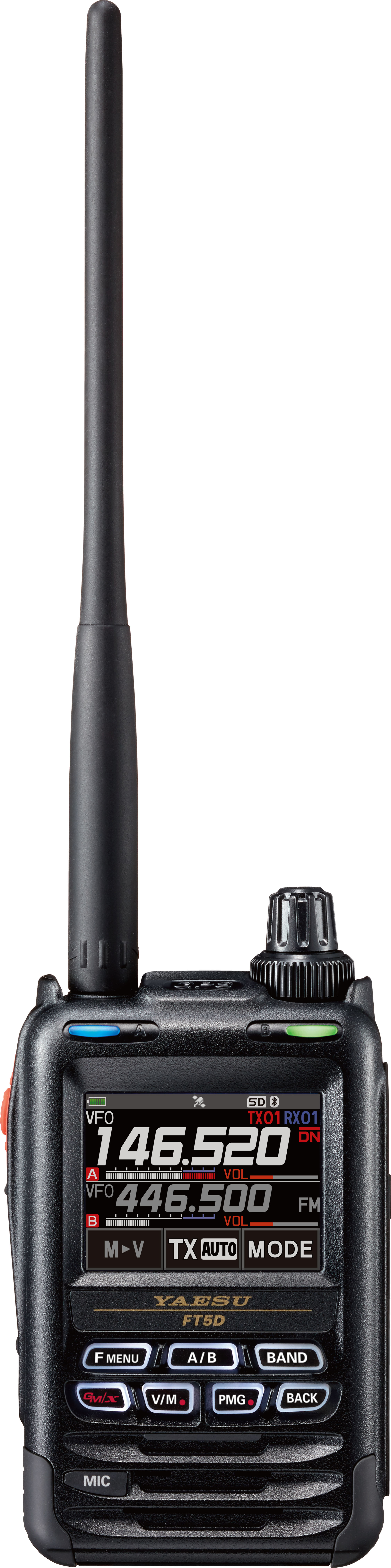
The FT5DR is not the radio I would tell every newly licensed operator to buy. It is what I would suggest when somebody already knows why the FT-70DR is not enough.
Yaesu’s current specifications include true simultaneous dual receive—including V+V, U+U and V+U combinations—C4FM, integrated GPS, a 1200/9600 bps APRS modem, a 2200 mAh battery, microSD support, a touch interface and IPX7 waterproofing.
That combination makes it materially more useful for events, APRS activity, travel and operators who actively monitor two frequencies. It is not simply the “more expensive FT-70.”
Yaesu is also still supporting the platform: its current product page lists a 2025 firmware package for the FT5DR.
But if your first goal is pressing PTT on a local repeater, most of those features do not help you make the first contact. Spend the difference only after you can explain which FT5DR feature you will actually use.
Best for: System Fusion operators who also want APRS, GPS, true dual receive and a much deeper field/event feature set.
Skip it if: you are still learning basic repeater operation or only need ordinary Fusion access.
6. Icom ID-52A PLUS
The ID-52A PLUS belongs here for the same reason the FT-70DR belongs here: digital infrastructure should choose the radio more often than a generic product ranking does.
If your nearby digital activity is D-STAR, Icom’s current ID-52A PLUS gives you 2 m/70 cm analog FM and D-STAR in the same handheld, with GPS, Bluetooth 5.3, USB-C charging, a color display and IPX7 construction.
Icom’s DR function can use location information to help select nearby D-STAR repeaters, while Terminal and Access Point modes add Internet-assisted D-STAR options through compatible software and network configurations.
The radio also offers 1,000 memory channels, dual watch including DV/DV, microSD support and expanded airband reception.
That is a lot of radio for somebody who does not have D-STAR activity nearby. Before spending at this level, check local repeaters and read our digital voice ecosystem comparison.
Best for: someone who knows D-STAR is the digital system they actually want to use.
Skip it if: you are paying for D-STAR because it appears more advanced rather than because you have a real use for it.
7. Yaesu FT-60R
The FT-60R is unusual because a radio introduced many years ago remains in Yaesu’s current 2026 handheld catalog.
Its appeal is not USB-C, GPS or a modern display—it has none of that. Its documented receiver is a traditional double-conversion superheterodyne design, and the radio remains interesting for operators who value a conventional analog platform and who operate in areas where strong nearby RF can make inexpensive wide-open receivers struggle.
It is still a 5 W 2 m/70 cm analog radio with a large memory system and wide receive coverage, but the age shows in the power system: the standard documentation centers on a 1400 mAh NiMH battery rather than the newer Li-ion/USB-C convenience found elsewhere.
That is why I would not put it ahead of the FT-65R for a normal beginner in 2026. It is a specialist alternative for somebody who understands why the old-school design is attractive.
Best for: analog operators who prefer the traditional Yaesu architecture or specifically care about receiver behavior near strong signals.
Skip it if: battery convenience, USB-C, digital modes or a modern interface matter more.
FT-60R or FT-65R?
Wholly Outdoor has a dedicated comparison of these two analog Yaesu handhelds. It is the most useful owned video here if you are specifically deciding between the simpler modern Li-ion FT-65R path and the older FT-60R architecture.
How to Choose Your First Handheld Ham Radio
1. Start With Your Local Repeaters, Not the Radio Catalog
Before comparing screens and power levels, find out what you can actually use.
Search RepeaterBook and check your local amateur-radio club.
Ask:
- Are the repeaters primarily 2 m or 70 cm?
- Is there active 1.25 m / 220 MHz use?
- Are they analog FM?
- Do they use System Fusion, D-STAR or DMR?
- Are those digital repeaters actually active?
Paying for a digital ecosystem that nobody around you uses is one of the easiest ways to overspend on a first handheld.
2. Programming Support Can Matter More Than Another Feature
Your handheld becomes useful after your local repeaters are correctly loaded into it.
That means frequencies, offsets, CTCSS/DCS tones, memory labels and—in more advanced radios—zones or digital configuration.
The official CHIRP supported-radio list currently includes the BF-F8HP Pro and many other common handhelds. Manufacturer software remains the right path for some models and advanced features.
Our programming cables and software guide explains the backup-first workflow and which radios actually need a separate cable.
3. Do Not Buy Your First HT by Wattage
The difference between 5 W and a larger handheld power claim is much smaller than beginners often expect.
Elevation, terrain, buildings, antenna position and the repeater’s own location can dominate the result. Yaesu’s own FT-65R support material explicitly notes that the same handheld may have very limited range at ground level yet communicate much farther from elevation.
If the existing radio almost reaches the repeater, first test outdoors, move higher and then consider our handheld antenna recommendations.
4. Analog vs Digital Is an Ecosystem Decision
Analog FM remains the easiest universal starting point for local repeater communication.
Digital becomes valuable when the people and infrastructure you want to use support it.
LOCAL SYSTEM FUSION → FT-70DR / FT5DR
LOCAL D-STAR → ID-52A PLUS
LOCAL DMR → SEE DMR BUYER GUIDE
DMR, D-STAR and System Fusion do not directly interoperate over RF simply because all three are “digital.” Read our digital voice comparison before committing.
5. Extra Bands Need Local Activity
The BF-F8HP Pro’s 1.25 m capability can be genuinely useful—but only where there are 220 MHz repeaters, simplex activity or another reason to use it.
Check local infrastructure first. If 1.25 m is dead in your area, do not choose an otherwise less suitable radio simply to collect another band.
6. APRS Is Different From GPS
A radio advertising GPS does not automatically mean it can transmit APRS position packets.
The BF-F8HP Pro has GPS location tools. The UV-PRO and FT5DR are more interesting when APRS itself is part of the operating goal.
This distinction matters for hiking, events and portable ham-radio operation.
7. Receiver Behavior Matters in Strong-RF Areas
A receiver has to remain usable before another watt of transmitter output helps.
Strong commercial, paging, broadcast and other nearby transmitters can overload or desensitize some handheld receivers. That is one reason the FT-60R remains relevant despite its age.
If this is a known problem at your home or workplace, do not choose a radio solely because it receives the widest possible frequency range.
8. Check the Accessory System Before You Buy
The radio is the start of the ownership cost.
Check:
- replacement battery availability;
- programming cable requirements;
- speaker-microphone connector;
- antenna connector;
- charging method;
- manufacturer software/firmware support.
Our ham-radio accessories guide covers batteries, speaker microphones, headphones, cases and other useful additions without pretending every accessory is mandatory.
9. Know When a Handheld Is the Wrong Radio
If your real objective is reliable repeater access from a vehicle, a properly installed 25–50 W mobile with an external antenna solves a different problem from an HT.
See our best mobile ham radios before buying a third handheld to fix a car installation.
Likewise, if the radio lives at home, moving to a proper external VHF/UHF antenna can change your station far more than another handheld.
What to Avoid
- Do not choose by wattage alone. A larger advertised number does not translate directly into dramatically greater range.
- Do not buy a digital mode before checking local infrastructure. Fusion, D-STAR and DMR are different ecosystems.
- Do not assume GPS means APRS. Check what the radio can actually transmit and which protocols it supports.
- Do not pay for 1.25 m simply because three bands look better than two. Check whether you have useful 220 MHz activity.
- Do not order the radio before knowing how you will program it. Confirm cable and software support first.
- Do not replace the radio first when the problem is range. Test elevation and antenna placement.
- Do not use an HT to solve every station problem. Cars and permanent home stations usually benefit from external antennas and eventually different radios.
- Do not confuse a huge receive-frequency range with receiver quality. Strong-signal handling still matters.
What You May Need Alongside Your Handheld
Starting from nothing? See the complete order in which to buy the radio, programming gear and antenna.
Choose the correct connector and learn when elevation matters more than changing the whip.
CHIRP, manufacturer software, cables and the clean backup-first programming workflow.
Compare DMR, D-STAR and System Fusion before buying into a digital ecosystem.
If DMR is active locally, use the dedicated guide for codeplugs, talkgroups and current DMR choices.
Spare batteries, speaker microphones, headphones, cases and useful small tools.
Build a lighter POTA/SOTA kit and decide when a handheld is enough.
Move up when a vehicle needs more power and a permanently external antenna.
Handheld Ham Radio FAQ
What is the best handheld ham radio for a beginner?
For a beginner primarily interested in ordinary 2 m and 70 cm analog repeaters, the Yaesu FT-65R remains my default choice. Choose the BF-F8HP Pro if 1.25 m, GPS, USB-C and extra monitoring features matter more.
Is the BF-F8HP Pro better than the Yaesu FT-65R?
It has more bands and more features, but that does not automatically make it the better first radio. Choose the BF-F8HP Pro for tri-band operation, GPS, USB-C and large channel capacity; choose the FT-65R when simplicity and straightforward analog repeater use matter more.
Is 10 W much better than 5 W on a handheld?
Not in the way beginners often expect. Antenna efficiency, elevation, terrain and the path to the repeater usually affect real-world communication much more than the headline difference between these handheld power levels.
Should my first handheld support digital voice?
Only when you have a reason to use it. Check nearby repeaters and local club activity first. If Fusion, D-STAR or DMR is active locally, choose the corresponding ecosystem rather than buying “digital” generically.
What is the best handheld ham radio with APRS?
The BTECH UV-PRO is the more approachable analog/APRS route here. The Yaesu FT5DR is the substantially more advanced choice when you also want System Fusion, true dual receive and a deeper field-radio feature set.
What is the best handheld for D-STAR?
The Icom ID-52A PLUS is the D-STAR recommendation here. It combines analog FM with D-STAR, GPS, Bluetooth and USB-C, but it only makes sense as a premium purchase when D-STAR is actually useful to you.
Do I need a programming cable?
It depends on the radio. Some models need a dedicated cable for convenient computer programming, while the UV-PRO can use its supported phone-app workflow. See our programming guide before ordering.
Will a handheld reach my local repeater?
That depends heavily on repeater height, your elevation, terrain, buildings and antenna placement. Try outside and from higher ground before concluding that you need a more powerful radio.
Should I replace the stock antenna immediately?
No. Learn what the stock setup can do from several locations first. If the limitation really is the antenna, continue to our handheld antenna upgrade guide.
Useful Handheld Radio Resources
- RepeaterBook — check nearby repeater bands and digital modes before buying.
- CHIRP Supported Radios — confirm current CHIRP compatibility.
- Yaesu Current Handheld Lineup — manufacturer listings, manuals, firmware and accessories.
- BTECH BF-F8HP Pro Support — current specifications, firmware and programming information.
- BTECH UV-PRO Support — APRS, Bluetooth, GPS and app-programming documentation.
- Icom ID-52A PLUS — official D-STAR features, specifications and software.
Licence note: You do not need equipment to take an amateur-radio exam. Transmitting requires the appropriate amateur-radio licence and operating privileges for the frequency and mode you use.
Wholly Outdoor is not affiliated with the FCC, NCVEC, ARRL, Yaesu, BTECH, Baofeng, Icom, CHIRP or RepeaterBook.